

Escalation procedures are documented, time-bound paths that move an issue beyond its normal owner once authority, skill, or time limits run out. Done right, they unblock stalled work, protect service-level agreements, and keep customers from feeling ignored. The first move isn't writing a policy document. It's picking one critical workflow and writing down its trigger, its owner role, and its clock.
TL;DR:
- Escalation procedures are triggered by clear, measurable criteria such as SLA breaches, authority limits, or unresolved conflicts, not subjective judgments.
- An effective escalation matrix should have no more than four levels, with roles and backups assigned, and it must be tested and accepted by the responsible owners before deployment.
- Automating escalation rules with integrated tools ensures timely alerts, multi-channel notifications, and consistent handoffs, which reduces manual errors and delays.
- Regular review of escalation metrics like response times, success rates, and automation effectiveness helps identify gaps and improve the process continuously.
- Documentation and training are crucial; runbooks, role clarity, and simulation exercises ensure responders understand their triggers, responsibilities, and how to escalate effectively.
Table of Contents
- What Do Escalation Procedures Actually Cover?
- What Are the Types and Levels of Escalation?
- How Do You Design an Escalation Matrix?
- Building Escalation Rules Into Your Tools
- How Do Runbooks Connect to Escalation?
- Communication Rules and Escalation Metrics
- How Continuity Tooling Reduces Escalation Volume
- Who Owns Training for Escalation Procedures?
- Legal and Compliance Considerations for Escalation
- Adapting Escalation to IT, Support, and Project Work
- Common Pitfalls in Escalation Procedures
- A Pragmatic Take on Rolling This Out
- Where MindVault Fits Into Your Escalation Strategy
- Sources
- FAQ
What Do Escalation Procedures Actually Cover?
Escalation procedures apply anywhere a normal owner hits a wall: a technician lacks the access to fix something, a support agent can't authorize a refund, a project lead needs a decision above their pay grade. That's different from routine ticket routing or a standard incident alert, which stay inside the normal chain of ownership.
An escalation process exists for the moment normal ownership stops being enough. Objective criteria trigger it, not a gut feeling. Time, value, risk, and missing approval are the usual four.
Some situations almost always qualify:
- A frontline responder lacks the authority to approve a fix, refund, or exception.
- An SLA clock is about to breach with no resolution path in sight.
- Two teams disagree on who owns a blocker, and work has stalled for more than a few hours.
- A security or compliance concern surfaces that the current owner isn't cleared to handle alone.
Not every hard problem deserves escalation. A ticket that's simply taking a while, or a question a teammate could answer in Slack, doesn't need a formal handoff. Escalating too freely trains people to skip the first line entirely, and that defeats the purpose of having one.
What Are the Types and Levels of Escalation?
Three types cover almost every real-world case. Hierarchical escalation moves an issue up the management chain when a decision needs more authority, like a discount beyond an agent's limit. Functional escalation moves sideways to a specialist team with different skills, like handing a database problem from a generalist to a database engineer. Automatic escalation triggers on a clock or a rule, with no human judgment involved, like a ticket that reroutes itself after 30 minutes of silence.
A workable escalation matrix rarely needs more than three or four levels. A simple structure looks like this:
- Level 1: The first responder, working the issue with standard tools and normal authority.
- Level 2: A senior specialist or team lead, brought in when Level 1 can't resolve the issue within its time window.
- Level 3: A manager paired with a technical specialist, handling both the customer relationship and the actual fix.
- Level 4: Executive or cross-functional leadership, reserved for major outages, legal exposure, or brand-level risk.
That Level 3 pairing matters more than people expect. An escalation matrix works best when a relationship owner (someone who talks to the customer) sits next to a specialist (someone who fixes the problem). Splitting those roles without pairing them creates a dark handoff, where the customer hears nothing while the fix owner works in silence.
How Do You Design an Escalation Matrix?
A working matrix isn't a wall of policy text. It's a table anyone can scan in under a minute, built through six concrete steps.
- Map the workflow. Write down every point where a normal owner might get stuck.
- Write objective triggers. Replace "escalate if needed" with specific, observable criteria: elapsed time, dollar value, customer tier, or missing approval.
- Assign roles, not names. Every level needs an owner role and a backup role, so the matrix survives vacations and turnover without a rewrite.
- Set clocks from your SLA. Escalation deadlines should sit comfortably before the customer-facing promise breaks, not at the exact breach point.
- Require a context packet. Nothing should escalate without the issue summary, impact, what's already been tried, and any relevant logs or ticket links.
- Write handoff rules. Specify how the next owner is notified, how fast they must acknowledge, and what happens if they don't.
Severity language should be plain and testable. A P1 might read: "Customer-facing outage affecting more than 25% of users, no workaround available, escalate within 15 minutes." A P4 might read: "Cosmetic issue, no customer impact, escalate only if unresolved after five business days." Vague thresholds like "urgent" or "high priority" invite arguments during the exact moment nobody has time for one.
Name roles, never people, and require the assigned role owner to accept the matrix before it goes live. A matrix built without buy-in from the people who'll actually staff Level 2 and Level 3 tends to fall apart the first time it's tested under real pressure.
Building Escalation Rules Into Your Tools
A matrix on paper only works if your tools enforce it. That means enriching every alert with the owner's name, a runbook link, recent deploy history, and any files the next responder will need before they even open the ticket.
Atlassian's approach to escalation policies centers on this exact idea: rules that define who gets notified, who to escalate to if the first responder doesn't respond, and how the handoff actually happens. Automation handles the routing so nobody has to remember the chain manually.
Multi-channel fanout matters more than most teams realize. Page, text, and call, in that order, with an acknowledgement window tied to your SLA. If nobody acknowledges within that window, the system should escalate automatically rather than wait for a human to notice the silence.
Treat your escalation policy like production code. Store it in version control, test changes before they ship, and run periodic game days where you simulate a breach and watch whether the real chain fires the way the document says it should. Policies that only exist in a slide deck rarely survive contact with a 2 AM outage.
How Do Runbooks Connect to Escalation?
A runbook is what the next person opens the moment an issue lands on their desk. It needs clear steps, a way to verify each step worked, a rollback plan if it didn't, and a short list of pre-approved actions safe enough to run without additional sign-off.

Automation should only run unsupervised for low-risk, well-tested actions, like restarting a known-flaky service. Anything touching customer data, billing, or irreversible changes stays human-first, even under time pressure.
Test automation the same way you'd test any critical system: staging dry runs first, then periodic game days that simulate real failures. Track how often automated actions succeed versus how often a human has to step in and override them. That ratio tells you whether your automation is actually ready for production, or just looks ready on a slide.
Communication Rules and Escalation Metrics
Telling a customer their issue has escalated isn't a failure message. Explaining who's taking over and when they'll follow up shifts the perception from neglect to proactive support, and that framing genuinely reduces churn risk.
Set your internal alert to fire before the customer-facing clock actually breaches, typically around 75% of the way through the allotted time. That buffer gives the next level room to actually act instead of inheriting an already-broken promise. Pair that with a mandatory update cadence, so a customer or stakeholder never goes more than an agreed interval without hearing something.
Four numbers tell you whether your escalation procedures are actually working:
- Mean Time to Acknowledge (MTTA): how fast someone confirms they've seen the escalation.
- Mean Time to Resolve (MTTR): how long the full resolution takes from trigger to close.
- Escalation success rate: the share of escalations resolved without bouncing to yet another level.
- Automation success rate: how often automated actions resolve the issue without human override.
Minor breaches deserve a monthly review. Anything hitting Level 3 or above deserves a full postmortem, documented and shared, so the same gap doesn't cause the same fire drill six months later.
How Continuity Tooling Reduces Escalation Volume
A lot of escalations trace back to the same root cause: nobody wrote down who owns what, or the documentation that exists is stale. Knowspan's MindVault platform ties every process to a named owner and a subject-matter expert, and flags when documentation hasn't been reviewed on schedule.
That matters directly for escalation volume. If the reason something escalated was "nobody knew who owned this," a governed knowledge system closes that gap before it turns into a 2 AM page. MindVault also tracks unanswered employee questions as a backlog, so the same knowledge gap that triggered an escalation this month gets resolved before it triggers another one next month. A continuity scorecard makes that exposure visible before it becomes an emergency instead of after.
Who Owns Training for Escalation Procedures?
An escalation matrix only works if the people staffing it know their role cold, before the pressure hits. Training needs to happen before the first real incident, not during it.
Frontline responders need to know the objective triggers for their level and, just as important, when not to escalate. Level 2 specialists need practice reading the context packet quickly, since a bad handoff wastes the time buffer the clock was supposed to protect. Level 3 managers need rehearsal in customer communication, because pairing a relationship owner with a technical specialist only works if the relationship owner actually knows what to say.
Run a tabletop exercise at least twice a year: simulate a P1, watch who does what, and time how long each handoff actually takes against the clocks in your matrix. New hires should shadow a live escalation, or a recorded one, before they're on call solo. Backup owners need the same training as primary owners, since a matrix that only trains the primary person collapses the moment that person is on vacation.

Ownership needs a name attached, not just a role. Someone should be accountable for keeping the matrix updated as teams reorganize, tools change, and people leave. Without that accountability, a matrix that was accurate at launch quietly drifts out of date within a year.
Legal and Compliance Considerations for Escalation
Regulated industries carry escalation obligations that go beyond internal SLAs. Healthcare, financial services, and industries handling personal data often have legal or contractual reporting clocks that run independently of your internal matrix, and missing one carries consequences well beyond a bad customer experience.
Data breaches, security incidents, and certain safety events frequently trigger mandatory notification windows to regulators, partners, or affected individuals. Those clocks don't pause for a normal Level 2 to Level 3 handoff, so any matrix in a regulated context needs a parallel track: one clock for operational resolution, one clock for compliance notification, both visible to whoever owns the incident.
Documentation discipline matters here in a way it doesn't for a routine service ticket. Auditors and regulators generally want proof that an issue was identified, escalated, and resolved within a defined process, not just that it eventually got fixed. That's part of why version-controlled escalation policies and stored context packets carry real weight. They're not just operational hygiene. They're the record you'd hand a compliance reviewer if asked.
None of this replaces legal counsel. Escalation policies in regulated industries should get a compliance or legal review before launch, especially around notification timelines and record retention, since those requirements vary by industry and jurisdiction.
Adapting Escalation to IT, Support, and Project Work
The core mechanics stay the same everywhere: trigger, owner, clock, handoff. What changes is the shape of the trigger and who sits at each level.
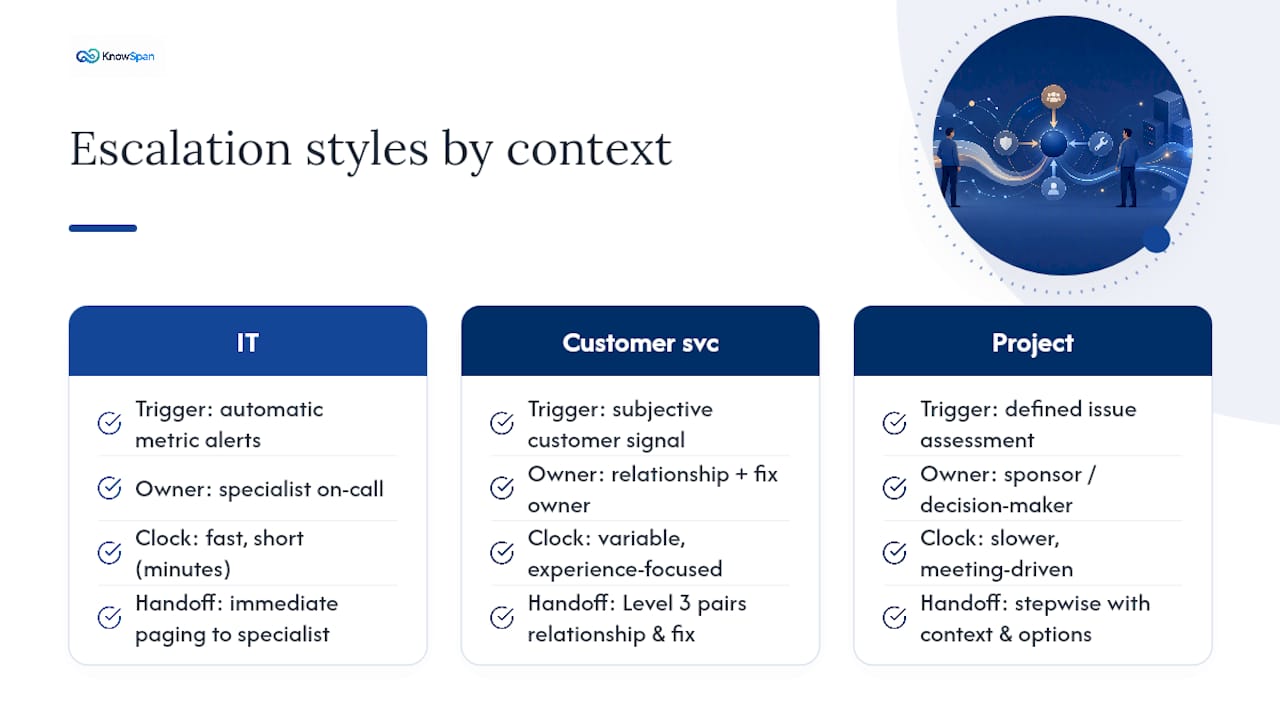
IT incident escalation leans hardest on automatic, clock-based triggers. Monitoring tools fire alerts, and Atlassian's on-call model shows why automation-first routing works so well here: the trigger is objective (a metric crossed a threshold), and the fastest path to resolution is getting the right specialist paged immediately, not waiting for a human to notice.
Customer service escalation is more relationship-driven. The trigger is often subjective. A frustrated customer, a refund beyond an agent's authority. The Level 3 pairing of relationship owner and fix owner matters most here, because the customer experience during the escalation is often what determines whether the relationship survives it.
Project escalation tends to run slower and more deliberate. A stepwise process works best: define the issue, assess the impact on timeline or budget, document what's already been tried, and present the decision-maker with actual options rather than just a problem. Project escalations rarely need a five-minute clock. They need a clear ask and enough context that a sponsor can decide in one meeting instead of three.
Common Pitfalls in Escalation Procedures
The most common failure is a matrix nobody trusts. If Level 1 doesn't believe Level 2 will actually respond, they'll route around the matrix entirely, and the whole system quietly stops being used.
Vague triggers cause a close second failure. "Escalate if the issue seems serious" forces every responder to make a judgment call under pressure, and different people will make that call differently. Objective, testable criteria remove that ambiguity before it costs you.
Missing backups is another frequent gap. A matrix that names one person per level, instead of a role with a backup, breaks the moment that person is out sick or on vacation. Stale documentation compounds this. If the escalation matrix hasn't been reviewed since the last reorg, the names and teams in it may no longer match reality.
Dark handoffs, where an issue moves to the next level but nobody tells the customer or stakeholder, erode trust fast even when the technical resolution is fine. And skipping the post-escalation review means the same root cause resurfaces months later, dressed up as a brand-new incident.
A Pragmatic Take on Rolling This Out
Skip the temptation to build a sprawling matrix covering every workflow on day one. Pick one critical process, write its trigger, owner, and clock, and run it for a month before expanding.
Escalation exists to unblock work, not to assign blame after something goes wrong. Treat it that way in training and in how you talk about it internally, and people will actually use it. Pilot, measure the four core metrics, then iterate. A matrix that's slightly incomplete but actively used beats a comprehensive one that sits in a wiki nobody opens.
— Jack
Where MindVault Fits Into Your Escalation Strategy
Knowspan built MindVault for exactly the gap that causes most bad escalations: nobody agreed in writing who owns what, and the documentation that's supposed to answer that question is out of date. MindVault ties every SOP to a named owner and subject-matter expert, and flags documentation that's overdue for review before it becomes the reason an incident stalls at Level 1.
The operational continuity dashboard shows you exactly where you're exposed. Which processes depend on one person, which runbooks haven't been verified recently, which knowledge gaps keep generating the same escalations month after month. Instead of discovering that dependency during an outage, you see it on a dashboard beforehand.
MindVault also turns unanswered employee questions into a tracked backlog for your subject-matter experts to close. If your team keeps escalating the same type of issue because the runbook doesn't cover it, that gap gets flagged and fixed instead of quietly repeating. If you run a managed service or a complex professional services operation and want a governed system behind your escalation policy, start with a look at the product overview and see whether the continuity model fits how your team actually escalates.
Sources
For a deeper look at escalation mechanics, Atlassian's guide to escalation policies covers automation and role-based routing in more depth. The escalation matrix template is worth adapting directly rather than building from scratch. For project-specific escalation, the stepwise process breakdown offers language you can borrow for sponsor conversations. Teams in professional services can also review Tawy Systems' service recovery guidance for client-facing escalation patterns.
- Escalation policies for effective incident management
- Escalation Matrix: Escalation Management, Template, Example
FAQ
What Are Escalation Procedures?
Escalation procedures are documented, time-bound paths that move an issue beyond its normal owner once authority, skill, or time limits run out. They typically define a trigger, an owner, a response clock, and a handoff rule.
What Are the Steps of Escalation?
A practical escalation follows six steps: define the issue, assess its impact, document what's been tried, confirm the correct level, present options to the decision-maker, and capture lessons learned once it's resolved. That sequence mirrors the project escalation process used across delivery teams.
Can You Give an Example of an Escalation Procedure?
A support agent can't approve a refund above their limit, so the ticket routes automatically to a team lead within 15 minutes if unresolved. The lead reviews the context packet, approves or denies it, and updates the customer directly.
What Are the Four Stages of Escalation?
Most matrices use four levels: a first responder with standard tools and authority, a senior specialist brought in when the first level stalls, a manager paired with a technical specialist for customer-facing issues, and executive or cross-functional leadership for major incidents. Not every issue needs to reach the top level, and most resolve at Level 1 or 2.
How Does Knowspan Support Escalation Management?
MindVault ties every process to a named owner and tracks whether documentation is current, which reduces the "nobody knows who owns this" gap that causes many escalations in the first place. Current pricing and plan details are available on the Knowspan site.
Recommended
This article was researched and drafted with AI assistance and reviewed by the KnowSpan team before publishing. It's provided for general informational purposes and isn't a substitute for professional legal, compliance, or IT advisory services. For guidance specific to your organization, please consult a qualified professional or contact us directly.