

Key person risk is a material, measurable exposure. Most businesses carry it in at least one role. The first move is not insurance. It's a continuity audit that flags where a single person, undocumented, holds a process hostage, followed by securing that knowledge before you need it.
TL;DR:
- Most businesses rely heavily on one person for critical processes, which can significantly reduce valuation and operational stability if that individual departs.
- Simple tests like sending key employees on vacation or handing over documentation to outsiders reveal hidden gaps in coverage and process robustness.
- Implementing structured documentation, assigning backups, cross-training staff, and developing a formal succession plan mitigate dependency risks and improve resilience.
- Technology platforms that automatically update, verify, and visualize process health help maintain current knowledge without relying on manual efforts.
- Culture that rewards sharing knowledge and normalizes asking questions prevents key person bottlenecks and ensures continuity before crises occur.
Table of Contents
- What Is Key Person Risk and Why Does It Matter?
- How to Identify Where Your Business Depends on a Single Person
- How Much Does Key Person Risk Cost?
- Practical Mitigation Tactics You Can Implement Now
- How a Governed Knowledge System Closes the Gap
- Company Culture Makes or Breaks Continuity Efforts
- Communication Strategies for Managing Key Person Risk
- Legal and Compliance Considerations
- Integration of Technology and Automation as Mitigation Measures
- Author Perspective: Realistic Priorities and Change Management
- Closing the Gap With MindVault
- Sources
- FAQ
What Is Key Person Risk and Why Does It Matter?
Key person risk is what happens when critical knowledge, client relationships, or decision authority sit with one person instead of a system. Lose that person to illness, resignation, or worse, and the business loses more than a headcount. It loses the ability to function in that area at all.
The OpenRisk Manual defines it as exposure that arises when organizational knowledge or decision authority is concentrated in a single individual, creating potential financial or reputational loss. That definition sounds abstract until you watch it play out. A founder who is the only person who can close enterprise deals. A senior engineer who never wrote down the deployment process. An office manager who is the only one who knows which vendor actually answers the phone.
Dependency shows up in daily friction long before it becomes a crisis:
- Approvals stall because only one person can sign off.
- New hires get trained by shadowing, not documentation.
- Client relationships live in one inbox, not a shared system.
- "Ask Sarah" becomes the informal answer to half your operational questions.
Buyers and investors notice this pattern fast, and it costs sellers real money at the negotiating table, a point worth understanding before you look at valuation numbers.
How to Identify Where Your Business Depends on a Single Person
You don't need a six-month audit to find your exposure. You need a few hours and the right questions.
Start with a role and process map. For every critical function, ask who else could step in tomorrow if that person vanished. If the honest answer is "no one," you've found a gap. Do this for client ownership, technical systems, vendor relationships, and any decision that requires one specific signature.
Two field-tested checks make this concrete:
- The vacation test. Send the person on a two-week vacation, phone off. Track what breaks, what stalls, and what nobody else can answer.
- The stranger test. Hand your documentation to someone outside the role and see if they can actually complete the task. Marsh's research on key person risk found documentation often only works for people who already understand the job, which defeats the purpose of writing it down at all.
Beyond formal tests, watch for quieter warning signs: response times that spike whenever one person is out, approval chains with a single gate, and handoffs that happen verbally instead of through a shared system.
Pro Tip: Run the vacation test on paper first. Ask the key person to list everything they'd worry about if they left for two weeks unannounced. Their answer is your risk map, free of charge.
How Much Does Key Person Risk Cost?
The cost shows up in two places: what you can sell your business for, and what you lose while you're still running it.
On the valuation side, buyers treat founder or owner dependency as a red flag. Forbes reporting on key person risk notes that over-reliance on one central operator makes deals harder to close and can meaningfully depress the price a buyer is willing to pay. M&A advisors treat demonstrated backups and repeatable processes as a direct lever on sellability, not a nice-to-have.
A business that runs on one person's memory is, to a buyer, a business that stops running the day that person leaves.
Operationally, the costs are less dramatic but constant: delayed decisions while everyone waits for one signature, lost revenue when a client relationship goes cold because only one rep knew the account history, and slower onboarding because training depends on tribal knowledge instead of a system.
Key man insurance can offset some of the financial shock of a sudden loss. It pays out cash, but it doesn't rebuild lost client trust, recreate undocumented processes, or replace the relationships that walked out the door. Insurance covers consequence. It does nothing for the operational gap underneath it.
Practical Mitigation Tactics You Can Implement Now
Fixing key person dependency is not one project. It's five habits, done in order.
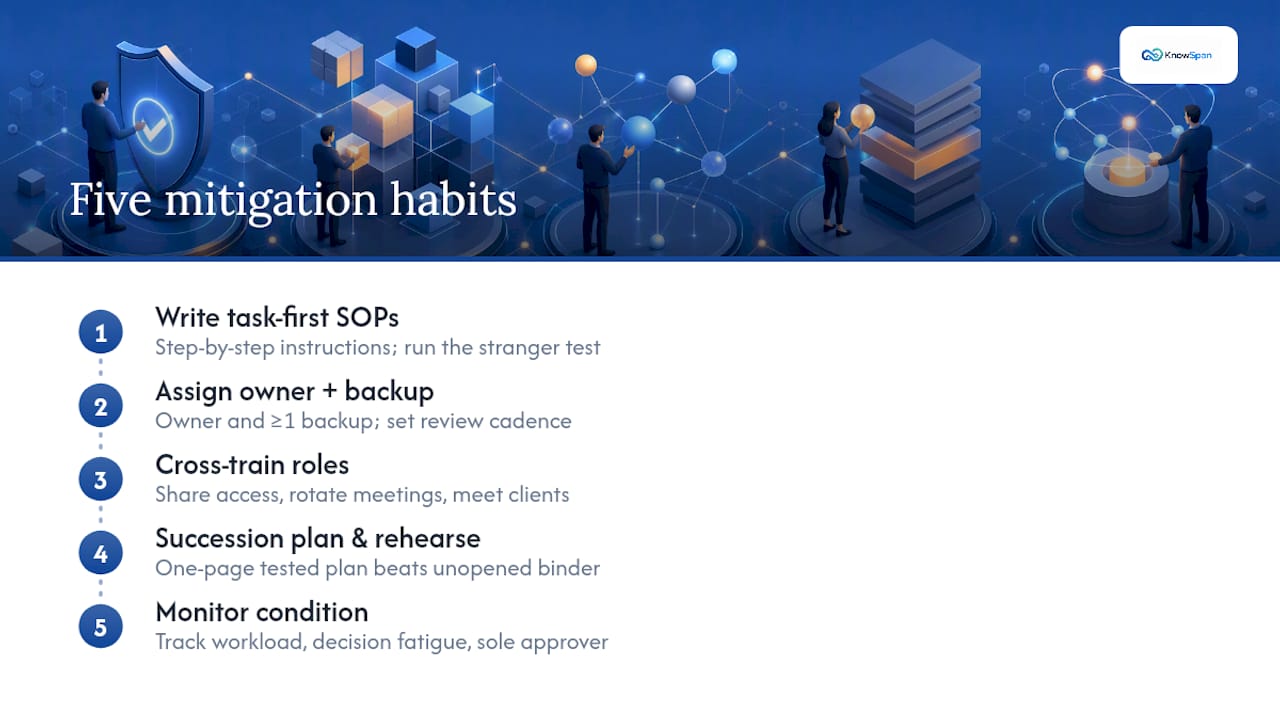
Document processes as task-first SOPs, then test them. Write instructions the way someone would actually perform the task, step by step, not as a policy summary. Then run the stranger test on it. Marsh's guidance confirms this validation step is what separates real documentation from paperwork nobody can use.
Assign an owner and at least one backup for every critical process, with a set cadence to review and re-verify the documentation. Ownership without a review date decays fast.
Cross-train key roles, especially anywhere a single person holds client relationships. Share account access, rotate meeting attendance, and make sure at least one other person has met the client face to face.
Build a simple succession plan and rehearse it. OCX Advisors notes that fewer than 22% of businesses in some practitioner surveys have a formal plan in place, which means most companies are betting on luck. A one-page plan that's actually been tested beats a thick binder that's never been opened.
Monitor condition, not just consequence. Standard tools measure what happens after someone leaves. Few track the current strain on the person still there. Watch workload, decision fatigue, and how often someone is the sole approver, because those signals show up before the resignation letter does.
Firms that specialize in operational dependency, like INTEGRA Consulting Services, can help structure this work if you need outside hands on the succession and change management piece.
How a Governed Knowledge System Closes the Gap
Most of the tactics above fail for a boring reason: nobody keeps the documentation current, and nobody can see where the gaps actually are until something breaks.
A governed knowledge platform fixes the visibility problem. Every process gets tied to a named owner and a subject matter expert, with a verification status attached, not just a file sitting in a folder somewhere. A continuity dashboard then surfaces which processes are stale, which have no backup coverage, and which depend on one person, before that dependency turns into an emergency call.
The measurement gap research from LifePillar Institute makes the case directly: traditional instruments track what happens after a key person leaves, not their current capacity to keep absorbing the load. A dashboard that tracks documentation age and backup percentage closes exactly that gap, and it gives leaders a number to act on instead of a hunch.
Company Culture Makes or Breaks Continuity Efforts
Culture decides whether documentation gets written honestly or gets skipped because "everyone already knows."
Some teams treat being indispensable as a badge of honor. The person who never takes vacation, who answers Slack at midnight, who is the only one who can fix production, often gets praised instead of flagged. That praise quietly rewards the exact behavior that creates key person dependency risk. If your culture celebrates heroics over handoffs, you're training your best people to hoard knowledge instead of share it.
The fix isn't a memo. It's changing what gets rewarded. Recognize people for training a backup, not just for being the backup themselves. Make documentation part of the job description for senior roles, not an afterthought squeezed in during slow weeks. SHRM's research on preparing for the loss of key employees points out that real preparation takes more than a replacement plan on paper. It requires governance that spreads authority across roles instead of concentrating it in one person by habit.
Psychological safety matters here too. If a backup is afraid to say "I don't know how to do this yet," gaps stay hidden until a crisis exposes them. Teams that normalize asking questions and flagging documentation gaps early catch key person exposure months before it becomes a resignation-day scramble.
Communication Strategies for Managing Key Person Risk
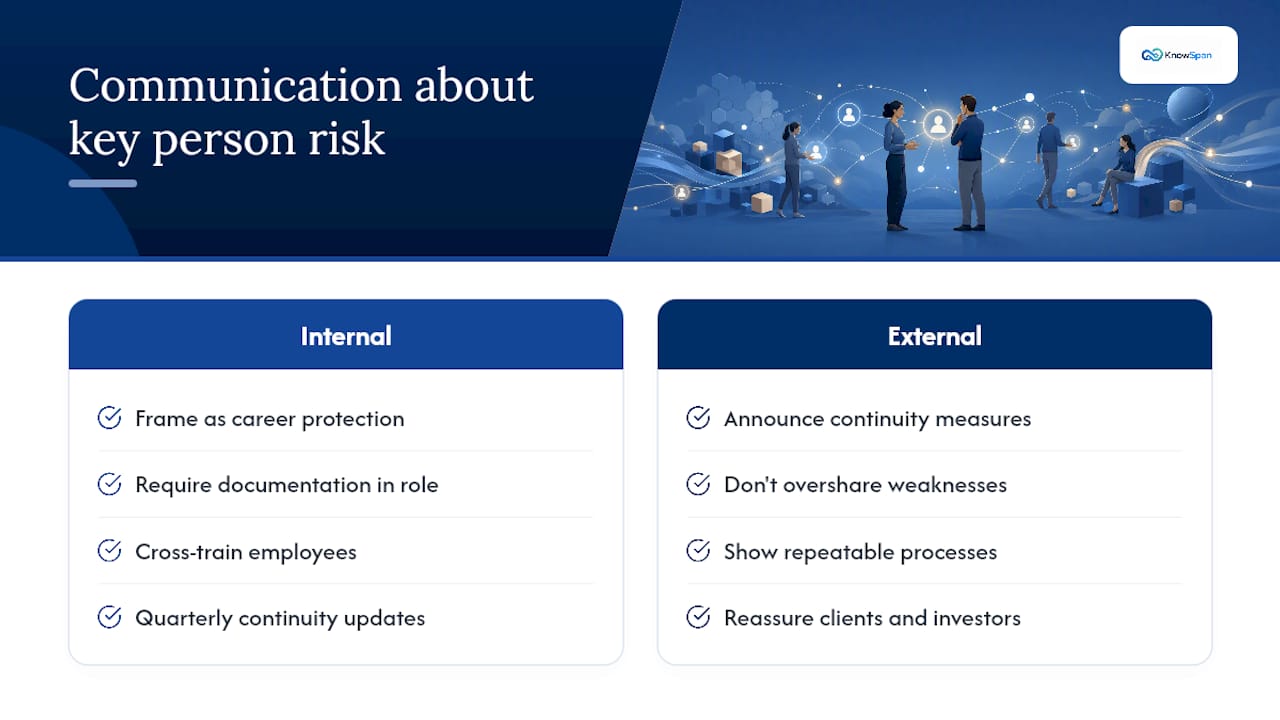
How you talk about this risk, internally and externally, shapes whether people cooperate with fixing it or quietly resist.
Internally, frame documentation and cross-training as protection for the key person, not a threat to their job security. Most employees who hold outsized knowledge worry that writing it all down makes them replaceable. Reverse that framing: a documented process frees them up for higher-value work and protects them if they get sick, take leave, or want to get promoted without leaving a hole behind.
Set expectations early with new hires that documentation and knowledge sharing are part of the role, not optional extras added later. This works far better than retrofitting the habit onto a team that's been operating informally for years.
Externally, especially with clients, investors, or buyers, be direct about what continuity measures exist without oversharing internal weaknesses. A client who knows there's a documented backup for their account manager feels more confident than one who's never asked and never been told. Investors and buyers, per the Forbes analysis on key person cost, respond well to evidence of repeatable process and backup coverage during diligence. Silence on the topic reads as a gap, even when one doesn't exist.
Regular internal updates on continuity progress, even a short quarterly note, keep the effort visible and prevent it from sliding back to "we'll get to it eventually."
Legal and Compliance Considerations
Key person dependency isn't just an operational headache. It carries legal and compliance weight, especially in regulated service businesses.
Contracts with clients, lenders, or investors sometimes include key person clauses that trigger specific obligations, renegotiation rights, or even termination options if a named individual leaves. Review existing agreements for this language before you assume the risk is only internal.
Employment agreements matter too. Non-compete and non-solicitation clauses, where enforceable, can slow a departing key person from immediately taking clients or proprietary knowledge to a competitor, but enforceability varies significantly by state and role, so this isn't a substitute for documentation and cross-training.
Regulated industries add another layer. Accounting firms, managed service providers, and property managers often face licensing or fiduciary requirements tied to specific credentialed individuals. If the only person with a required license or certification leaves, the business can face compliance gaps that go beyond lost revenue and into regulatory exposure. Mapping which roles carry a compliance requirement, not just an operational one, should be part of any continuity audit.
Board and investor governance documents may also specify succession requirements for founders or executives. Reviewing these obligations alongside your operational audit avoids surprises when a key person transition actually happens.
Integration of Technology and Automation as Mitigation Measures
Manual documentation efforts stall for a predictable reason: nobody has time to keep them updated, and nobody notices when they go stale until it's too late.
Technology closes that gap by making documentation part of daily workflow instead of a separate project. Automated verification cadences remind owners to review and re-confirm SOPs on a schedule, instead of relying on someone remembering to do it. Systems that let employees ask operational questions in plain language, with answers grounded in the organization's own documented knowledge, also surface where the documentation is thin. Every unanswered question becomes a visible gap instead of a silent one.
This matters more as businesses grow past the size where informal, tribal knowledge can scale. A 40-person shop can survive on hallway conversations. A 150-person one cannot. Automation and structured tracking are what let a growing service business keep the same level of operational memory it had when everyone sat in one room.
The goal isn't replacing human expertise with software. It's making sure that expertise gets captured, verified, and made visible to the people who need it, before the person who holds it walks out the door.
Author Perspective: Realistic Priorities and Change Management
Start with your single riskiest process, not a company-wide overhaul. Pick the one where losing a person would hurt the most, fix it, and show the result. That proof point builds buy-in faster than any policy memo.
Tie documentation and backup coverage to actual performance reviews and onboarding checklists. If it's not measured, it won't stick. Expect this to move in sprints, not a straight line. Continuity work that treats progress as iterative outlasts programs built on a single big launch.
— Jack
Closing the Gap With MindVault
Auditing your key person risk manually gets you a snapshot. It goes stale the moment someone changes roles, and most spreadsheets never get updated again. MindVault is an operational knowledge platform designed to keep that picture current automatically instead of relying on manual updates.
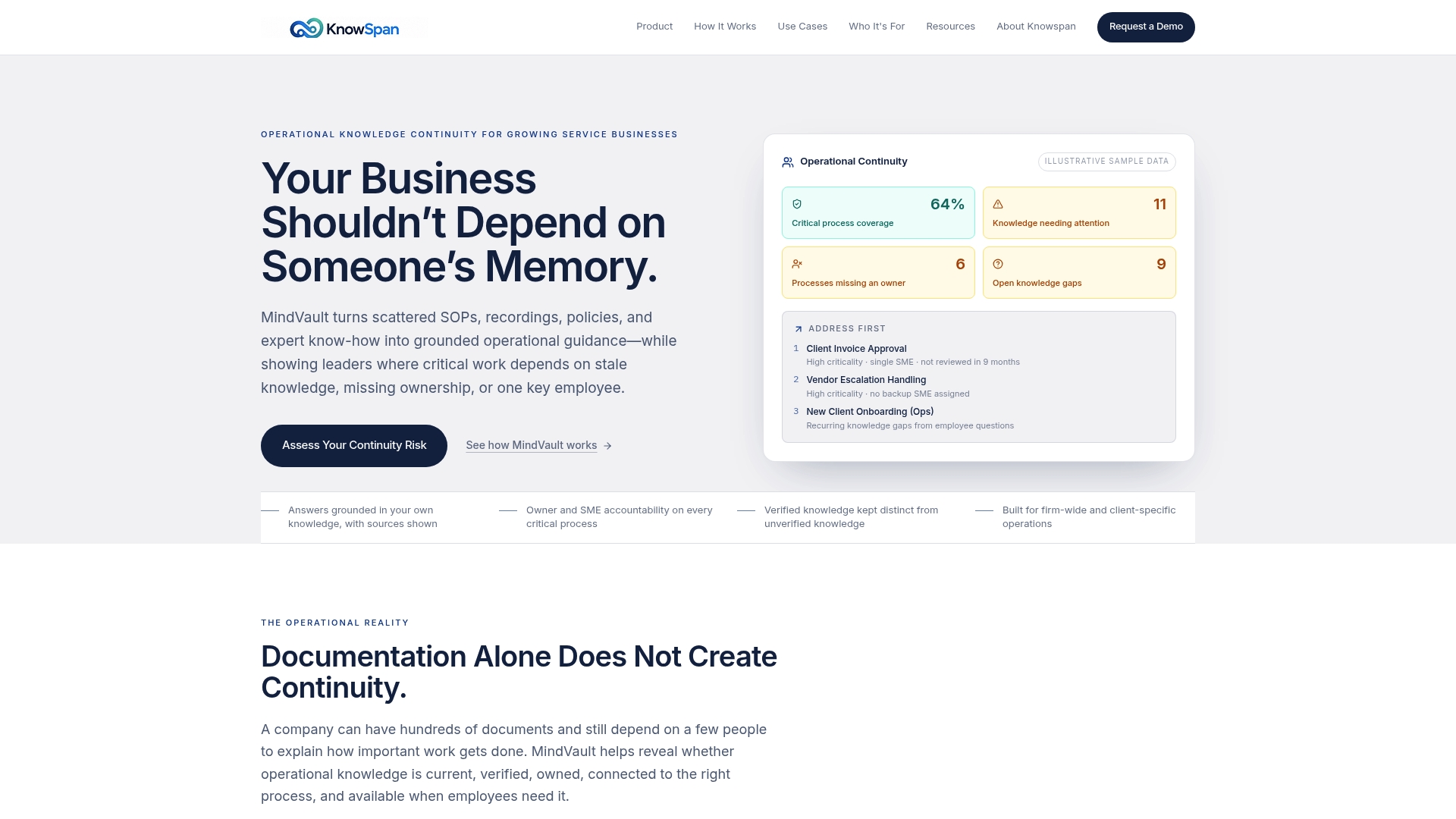
Every process in MindVault gets tied to a named owner and subject matter expert, with a verification status attached so you can see at a glance what's current and what's aging out. The Operational Continuity dashboard then flags exactly where you're exposed: stale documentation, missing ownership, or a process that still runs through one person and nobody else. Employees can also ask operational questions in plain language and get answers grounded in your own documented knowledge, with unanswered questions tracked as a backlog instead of disappearing into a Slack thread.
If you want a concrete starting point before a full rollout, run an Assess Continuity Risk check to see where your organization stands today. From there, you can look at the full product or see how implementation actually works for a team your size.
Sources
- Key Person Risk: What Is It Costing Your Business? | Forbes
- Key Person Risk | OpenRisk Manual
- Key-Person Risk: The Measurement Gap Between Consequence and Condition | LifePillar Institute
- Key person risk: a business problem | Marsh
FAQ
What Is Key Person Risk?
Key person risk is the exposure a business faces when critical knowledge, client relationships, or decision authority depend on one individual, so losing that person can cause financial or operational damage.
What Are the Disadvantages of Key Man Insurance?
Key man insurance pays out cash after a loss, but it doesn't rebuild lost client relationships, recreate undocumented processes, or fix the operational gap that caused the exposure in the first place.
Can You Give an Example of a Key Risk Indicator?
A common indicator is a spike in response times or approval delays whenever one specific person is out of office, signaling that a process has no real backup.
What Does "Key Person" Mean in a Business Context?
A key person is someone whose knowledge, relationships, or authority are so central to operations that their departure would meaningfully disrupt the business, whether that's a founder, a technical expert, or a client relationship owner.
How Do You Reduce Key Person Dependency?
Document processes as task-first SOPs, assign backup owners, cross-train critical roles, and use a governed platform like MindVault to track verification status and surface single-owner processes before they become emergencies.
Recommended
This article was researched and drafted with AI assistance and reviewed by the KnowSpan team before publishing. It's provided for general informational purposes and isn't a substitute for professional legal, compliance, or IT advisory services. For guidance specific to your organization, please consult a qualified professional or contact us directly.