

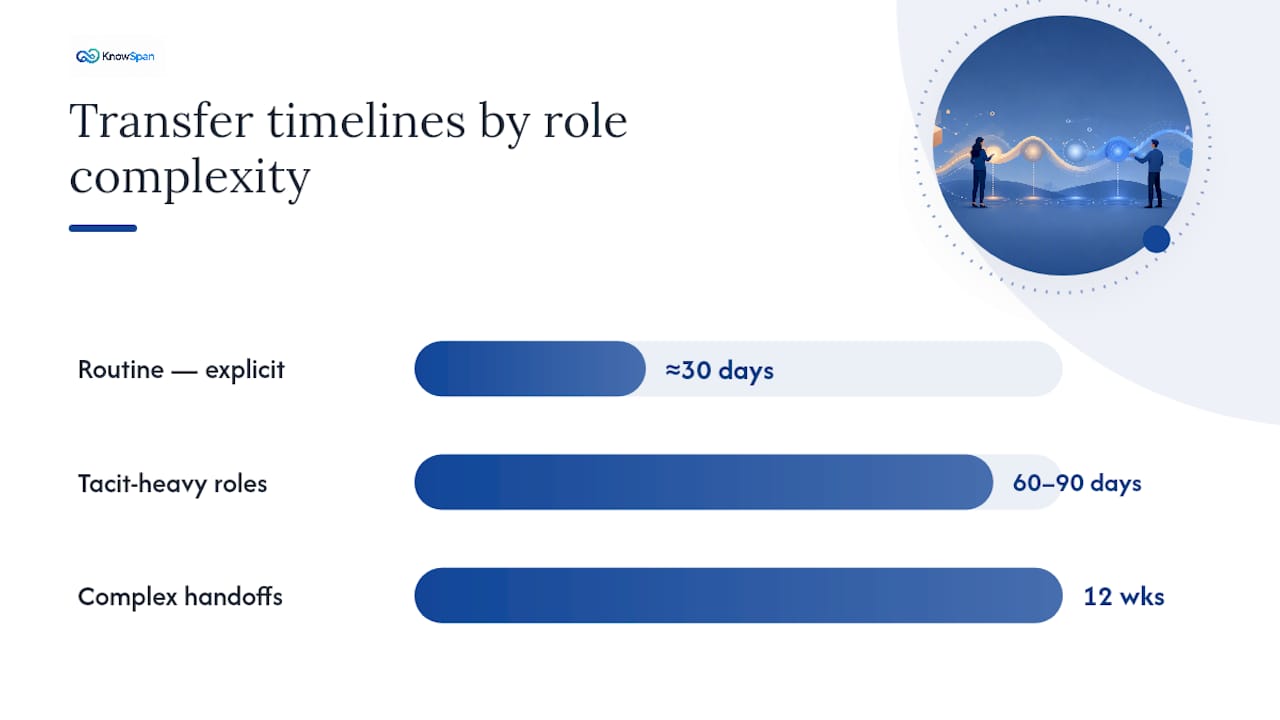
A knowledge transfer plan is a documented, verified handoff where the incoming person can run the role independently, not just a folder of notes. The immediate move: copy a template, list your top three knowledge areas, assign an owner and a recipient, and set a first milestone. Give the whole process 30 days for routine roles and up to 90 for complex, tacit heavy ones.
TL;DR:
- Prioritize knowledge transfer for high-impact, low-replaceability areas first, and store all documentation in a single, accessible repository with clear naming conventions.
- Follow a four-stage process: identify and prioritize, document and shadow, test and fix gaps, and schedule follow-up reviews to ensure effective handoff.
- Match transfer methods to knowledge types, using documentation for explicit knowledge, shadowing for tacit knowledge, and relationship-building for relational knowledge.
- Verify success through reverse teaching and track operational KPIs such as time to independent work, error rate, and support volume, updating documentation regularly.
- Assign a dedicated owner to each process before documenting, and avoid rushing complex handoffs, extending timelines up to 90 days when necessary.
Table of Contents
- What should a knowledge transfer plan include?
- How Do You Run a Knowledge Transfer Process Step by Step?
- Which Transfer Method Fits Which Type of Knowledge?
- How Do You Verify a Knowledge Transfer Actually Worked?
- What Mistakes Sink Most Knowledge Transfer Plans?
- How Does a Governed Knowledge Platform Support Ongoing Transfer?
- A Practical Note From Jack
- Ready to Move From a Template to a System?
- Sources
- FAQ
What Should a Knowledge Transfer Plan Include?
A working handoff plan starts with a template you can fill out today, not a strategy deck. Every knowledge management plan needs the same core fields, whether you're handing off a bookkeeping role or a 20-year client relationship.
Here's the field list that matters:
- Objective/scope: what the role or project actually covers
- Knowledge area: the specific process, account, or skill being transferred
- Knowledge type: explicit (written down), tacit (in someone's head), or relational (tied to a relationship)
- Current owner (SME): who holds the knowledge now
- Recipient(s): who's taking it over
- Transfer method: documentation, shadowing, recording, mentoring
- Timeline/milestones: target dates for each transfer step
- Verification method: how you'll confirm the knowledge actually moved
- Storage location: where the finished documentation lives
- Status: not started, in progress, verified, stale
- Notes: exceptions, dependencies, open questions
You won't transfer everything at once, so rank items before you start. Deloitte recommends prioritizing knowledge by business criticality and how well it's already documented, using analytics to flag the high-demand topics that resolve the most operational issues. A simple version of that idea: score each knowledge area on impact (how badly the business breaks without it) and replaceability (how hard it is to find or train someone else who has it).
High impact and low replaceability means it goes first.
Where you store the finished plan matters as much as what's in it. Pick one authoritative repository, not a mix of shared drives, wikis, and someone's personal notes folder. Set naming conventions and access rules up front, or you'll end up with three versions of the same runbook and no way to tell which one is current. This single-source-of-truth requirement is where most informal handoffs quietly fail: the knowledge existed, but nobody could find it six months later.
How Do You Run a Knowledge Transfer Process Step by Step?
Academic research on organizational knowledge transfer consistently points to a four-stage process: initiation, capture, ramp-up, and integration. Mapping your plan to these stages keeps the work from stalling out after the first documentation push.
- Initiation (identify and prioritize). The transfer owner and departing SME sit down and list every knowledge area tied to the role. Rank them using the impact/replaceability method above. Deliverable: a prioritized list, done in the first week.
- Capture (document, record, shadow). This is the bulk of the work. The SME documents explicit processes, records short walkthroughs for tacit steps, and starts shadowing sessions with the recipient. NASA's continuity guidance recommends building this capture into normal project planning instead of treating it as a bolt-on task at the end.
- Ramp-up (test handoffs, fix gaps). The recipient starts doing the work while the SME watches and corrects. Any gap that surfaces here gets fixed immediately, not noted for later.
- Integration (embed and schedule reviews). The recipient works independently. The transfer owner schedules a follow-up review (30, 60, and 90 days out) to catch anything that slipped.
Owner responsibilities at each stage:
- SME: documents, demonstrates, answers questions during shadowing
- Transfer owner: tracks the plan, chases deadlines, confirms sign-off
- Manager: removes blockers, approves timeline changes
- Recipient: takes notes, asks questions, performs test runs
For timelines, match the bucket to the role's complexity. Routine, mostly explicit roles can move through all four stages in about 30 days. Roles heavy on tacit or relational knowledge, client-facing account management, technical troubleshooting, need 60 to 90 days, and some practitioner guides put complex handoffs at up to 12 weeks. Don't compress a 90-day handoff into three weeks because someone's last day got moved up. Push the departure date, extend a contractor, or accept a rougher transfer, but don't skip stages.
Acceptance criteria for sign-off should be specific: the recipient completes a defined task without help, or answers a set of scenario questions correctly. Vague sign-off ("feels ready") is how gaps make it past the finish line.
Which Transfer Method Fits Which Type of Knowledge?
Not every knowledge area needs the same treatment, and using the wrong method wastes everyone's time. There are three broad types worth knowing:
- Explicit knowledge: things you can write down clearly, like a step-by-step billing process or a software configuration.
- Tacit knowledge: judgment calls, pattern recognition, and "feel" that comes from experience, like knowing which client complaints need an immediate call versus an email.
- Relational knowledge: the trust and context built into a relationship, a client history, a vendor rapport, an internal political map.
Match the method to the type:
- Explicit → documentation, templates, checklists, SOPs
- Tacit → shadowing, mentoring, reverse teaching, short recorded walkthroughs
- Relational → joint introductions, warm handoff meetings, relationship maps noting history and preferences
Research on organizational knowledge transfer backs this up directly: tacit knowledge requires high-bandwidth mechanisms like direct interaction and shadowing, because a document can't carry the nuance a mentor picks up in five minutes of watching someone work. If your only tacit-knowledge method is a written procedure, it will fail. Low-interpretability knowledge, things with a single correct answer and no judgment involved, transfers fine through documentation alone. Anything involving judgment, timing, or reading a situation needs a human in the room.
Pro Tip: Record a short walkthrough (10 to 15 minutes) of the SME performing the task, then follow it with a structured Q&A session where the recipient asks anything unclear. This cuts SME time roughly in half compared to open-ended shadowing, because the recording handles the repeatable part and the Q&A handles the judgment calls.
How Do You Verify a Knowledge Transfer Actually Worked?
Documentation existing isn't the same as knowledge transferring. The most reliable check is reverse teaching: the recipient performs the task while the SME watches and only corrects when something's actually wrong. If the recipient can do it without prompting, the transfer worked. If not, you've found the gap while there's still time to fix it.
Track a small set of operational KPIs to confirm the handoff held up over time:
- Time to independent execution: how many days until the recipient works without SME support
- Error rate: mistakes per week in the first month versus month two
- Support ticket volume: how often the recipient still needs help
- Time to first successful case: how long until they close out a task solo, correctly
Documentation health matters just as much as the person. Every entry in your knowledge management plan should carry a last-verified date, a named owner, and a coverage score, how much of the role's real work the documentation actually addresses. A wiki page with no verification date is worth almost nothing six months from now.
Set an audit cadence and stick to it: check in at 30, 60, and 90 days after the handoff, and update the KT document each time. Practitioner guidance and case studies consistently find that early documentation combined with hands-on testing turns fragile handoffs into durable ones, while transfers checked only once at the end tend to reveal gaps too late to fix cheaply.
What Mistakes Sink Most Knowledge Transfer Plans?
Most failed handoffs share the same handful of root causes, and all of them have straightforward fixes.
- Starting too late. Waiting until someone's two-week notice to begin capture guarantees a rushed, incomplete plan, so best practices from TLCConsulting emphasize knowledge continuity in compliance-heavy environments to prevent such failures. Fix: build capture into onboarding and every project plan from day one, so documentation exists before anyone announces a departure.
- Focusing only on explicit knowledge. Writing everything down feels productive but misses judgment calls entirely. Fix: require shadowing and structured mentoring for any role with real complexity.
- Single-person dependency. If only one person understands a process, you have zero redundancy. Fix: assign backup owners and cross-train at least one other person on every critical process.
- Unfindable or unmaintained docs. Documentation scattered across five tools with no update schedule rots fast. Fix: one authoritative repository, consistent naming, and a set review cadence.
How Does a Governed Knowledge Platform Support Ongoing Transfer?
Spreadsheets and templates work for a single handoff. They break down when a business has dozens of processes, SMEs, and role changes happening at once. That's the gap a governed operational knowledge platform is built to close.
The features that matter for continuity go beyond storage:
- Owner assignment on every process, so there's always a named person accountable for keeping it current
- Verification status showing whether a process has been confirmed accurate, not just written once and forgotten
- Continuity exposure dashboard flagging where the business depends on stale documentation or a single key employee
- Backlog of unanswered employee questions, turning gaps people hit in real work into a tracked list subject-matter experts can resolve
The practical payoff is prioritized capture work instead of guesswork: leaders see exactly where exposure is highest and can direct SME time there first. When evaluating any tool for this job, check four things: does it enforce ownership, track verification, make knowledge actually searchable, and keep an audit trail of what changed and when.
A Practical Note From Jack
Most knowledge transfer plans fail for a boring reason: nobody assigned an owner. The documentation exists, the shadowing happened, but no single person was accountable for confirming the handoff worked. Assign that owner before you write a single procedure.
This week: pick your top three knowledge areas, assign an owner and recipient to each, and schedule the first shadowing session. This quarter: run your 30/60/90 day audits, track the KPIs, and update the repository. Skip either step and the plan looks finished on paper while quietly falling apart in practice.
— Jack
Ready to Move From a Template to a System?
A spreadsheet template gets one handoff done. It won't tell you, six months from now, which of your 40 documented processes has gone stale, or which ones depend entirely on one person who's about to take a new job. That's the problem MindVault is built to solve for service businesses running on SOPs, recordings, and expert know-how scattered across people and systems.
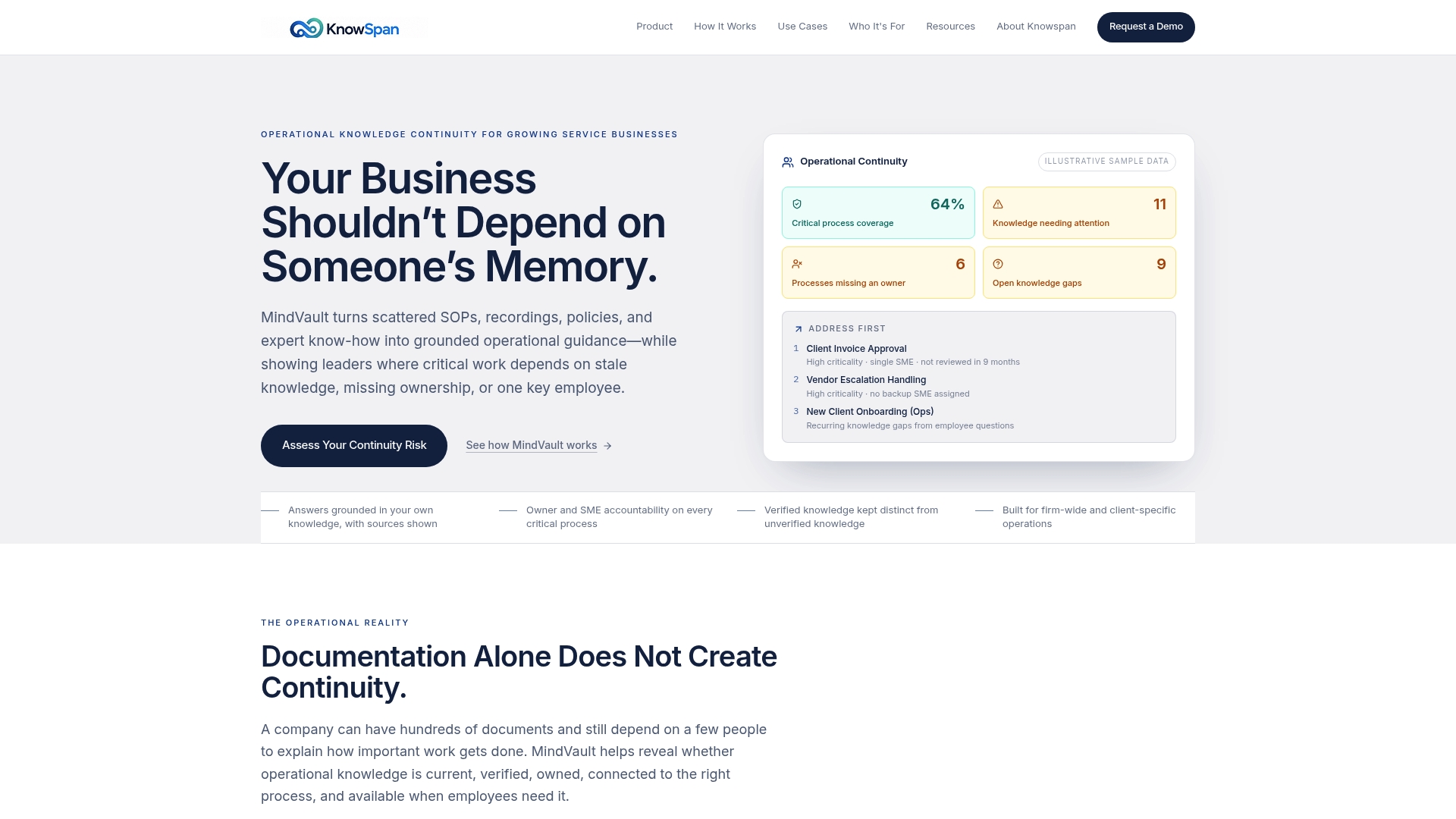
MindVault ties every process to a named owner and subject-matter expert, tracks whether each one has been verified, and surfaces exposure before it becomes an emergency through its continuity dashboard. Instead of guessing which processes are risky, you see it laid out. Instead of documentation nobody reads, employees ask questions in plain language and get answers grounded in your own operational knowledge, with sources shown.
If you manage operations at a managed service provider, an accounting firm, or a property management company, start by running a continuity risk assessment to see where your exposure actually sits. From there, check the MindVault product overview and request a demo to see how it applies to your own process library.
Sources
A few sources shaped the recommendations here and are worth a closer read if you're building this out further:
- Capturing institutional knowledge | Deloitte Insights
- Knowledge continuity: Supervisors guide — NASA
- Knowledge transfer organizations — CMU Tepper summary (Linda Argote)
- Strategies to Enhance Knowledge Transfer: Lessons from a Multinational Corporation
FAQ
What should a knowledge transfer plan include?
A working plan lists each knowledge area, its type, the current owner, the recipient, the transfer method, a timeline, a verification step, and where the finished documentation is stored.
What is a knowledge transfer program?
It's a structured, organization-wide effort, not a one-off checklist, that builds knowledge capture into onboarding, project work, and offboarding so critical process knowledge never depends on one person leaving unexpectedly.
What is a KT checklist?
A KT checklist is the short, field-level version of the plan: knowledge area, owner, recipient, method, timeline, and verification status, filled out for each item before a handoff is considered complete.
What are the four stages of knowledge transfer?
Initiation (identify and prioritize), capture (document, record, shadow), ramp-up (test handoffs and fix gaps), and integration (embed the knowledge and schedule follow-up reviews).
How long should a knowledge transfer plan take?
Routine, mostly explicit roles typically wrap up in about 30 days, while complex or tacit-heavy roles need 60 to 90 days to properly shadow, test, and verify the handoff.
Recommended
This article was researched and drafted with AI assistance and reviewed by the KnowSpan team before publishing. It's provided for general informational purposes and isn't a substitute for professional legal, compliance, or IT advisory services. For guidance specific to your organization, please consult a qualified professional or contact us directly.