

An operational maturity model grades whether a business runs on reliable systems or on the memory and effort of a few key people. Instead of a vanity score, a good assessment produces two things: an honest profile of where the organization actually stands, and one prioritized fix worth acting on. That second part is the whole point.
TL;DR:
- Organizations need concrete evidence, such as documented processes or dashboards, to justify claims of operating at higher maturity levels.
- Focused metrics like cycle time, rework rate, and mean time to recovery best indicate actual operational stability and control.
- Prioritizing fixes involves identifying dependencies and targeting the bottleneck that, when resolved, unlocks overall system improvements.
- Leaders must require evidence-based scoring and model the desired behaviors to prevent high scores based solely on perceived or unverified maturity.
- Using tools like MindVault enables ongoing ownership tracking, verification, and backlog management to sustain operational maturity improvements.
Table of Contents
- What Are the Core Components of Operational Maturity?
- What Are the Five Levels of Operational Maturity?
- How Do You Run an Operational Maturity Assessment?
- What Metrics Actually Show Operational Maturity?
- How Do You Prioritize Which Fix Comes First?
- Applied Example: Reducing Knowledge Risk With Governed Operational Knowledge
- Common Assessment Pitfalls, and Why Leaders Have to Model the Fix
- How Knowspan Supports Operational Maturity Gains
- Sources
- FAQ
What Are the Core Components of Operational Maturity?
Every serious operational excellence model breaks maturity into a handful of domains, and each one has a visible signature at both ends of the scale.
Process discipline separates documented, repeatable work from heroics. At low maturity, tasks live in someone's head. At high maturity, they live in a written procedure that anyone trained can follow.
Metrics and visibility measure whether leaders see problems as they happen or hear about them a month later in a report nobody read in time. Real-time dashboards beat static spreadsheets almost every time.
Quality and rework track whether defects get logged and their root causes fixed, or whether the same mistake gets patched over and over.
People and ownership ask a blunt question: does every process have a named owner and a trained backup, or does it depend on one irreplaceable employee?
Improvement rhythm is the cadence of turning problems into fixes, whether that's a weekly retro or a formal kaizen cycle. Microsoft's operational excellence maturity model frames this rhythm as a foundation you build early, tying testing and monitoring to the system's growth rather than bolting them on later.
What Are the Five Levels of Operational Maturity?
Most maturity frameworks use five stages, and the labels vary less than you'd expect across industries.
Level 1, ad hoc, looks like firefighting. Work gets done, but nobody could explain the process the same way twice.
Level 2, managed, means some documentation exists, though it's inconsistent and often out of date. Individual heroics still cover the gaps.
Level 3, defined, is where documented, standardized processes exist across the team, not just in one person's notes.
Level 4, measured, adds real metrics. Leaders track cycle time and quality with data, not gut feel.
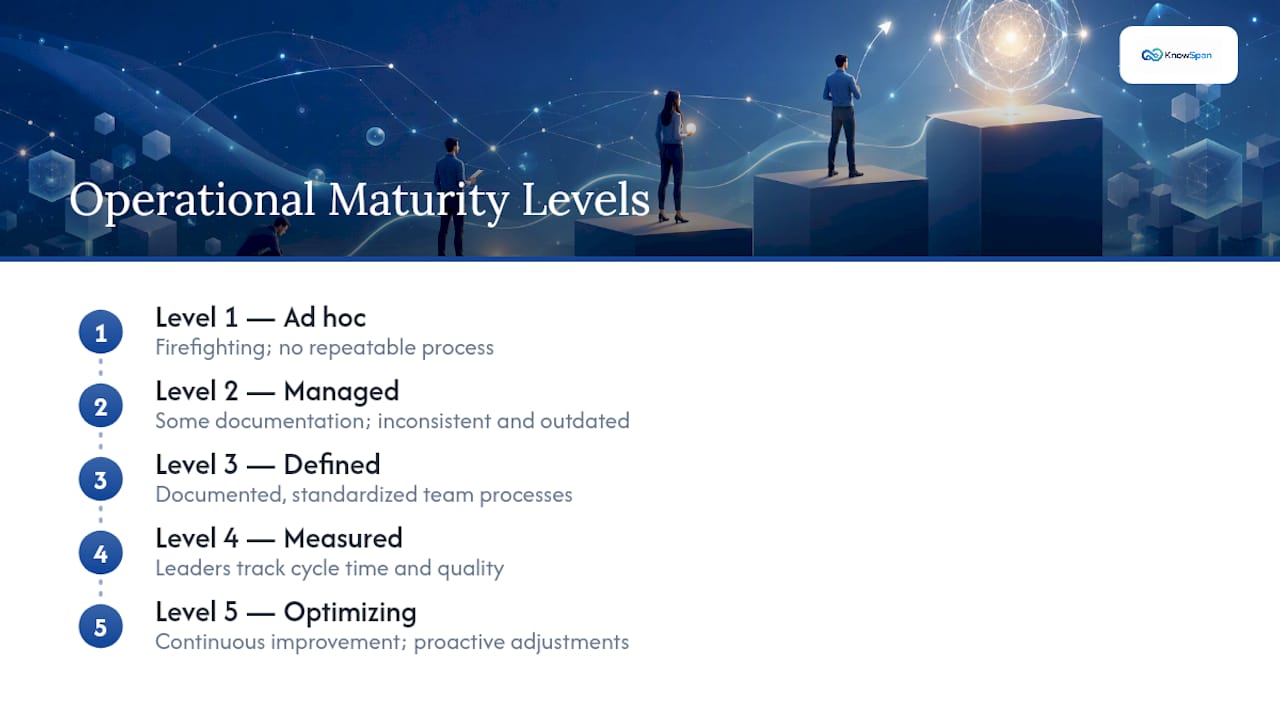
Level 5, optimizing, means the organization runs continuous improvement cycles and adjusts before small problems become big ones.
Before you claim any level above 2, you need evidence, not confidence. A team that says it's "Level 4" but can't produce a metrics dashboard is really at Level 2 with good intentions. Higher levels correlate directly with lower operational risk and more capacity to handle growth or turnover without a crisis.
How Do You Run an Operational Maturity Assessment?
A defensible assessment triangulates three evidence sources: hard data, direct observation, and frontline conversations. Skip any one of them and you get a skewed picture. Data alone misses context. Interviews alone miss what people don't realize they're doing wrong.
The single most important rule: require one piece of evidence for any score of 3 or higher. A self-scoring tool built around this principle keeps ratings honest, because a leader claiming "we're defined and measured" has to point to an actual document, dashboard, or log to back it up, per this self-scoring maturity tool.
You have three practical formats to choose from, depending on time and stakes:
- A 60-minute diagnostic works for a quick gut check, especially when you already suspect where the trouble is.
- A 16-question self-score gives a broader view across all five domains without much overhead.
- A consultant-facilitated assessment goes deeper. KPMG documents formats ranging from a 36-question rapid read to a 210-question detailed review, each with its own timeline and deliverable, per its IT maturity assessment framework.
Whichever format you pick, the output only matters if it turns into named, dated fixes. A scorecard with five weak dimensions and no owner assigned to any of them changes nothing.
Pro Tip: Run the 60-minute version first. If the findings surprise you, that's your signal to invest in a longer, facilitated assessment before committing budget to fixes.
What Metrics Actually Show Operational Maturity?
Skip vanity metrics. A focused set works better than a crowded dashboard nobody checks: cycle time, rework rate, mean time to recovery (MTTR), and backlog health. Each one tells you something different about whether the system is under control or just getting lucky.
One distinction matters more than people realize. Business-critical metrics, the ones tied to actual work volume and revenue, should be treated as workload data. Keep them separate from sampled monitoring telemetry, which only estimates system health from a slice of traffic. Microsoft's maturity guidance makes this split explicit, warning that conflating the two breaks recoverability when you need the numbers most, according to its maturity model documentation.
Review rhythm matters as much as the metrics themselves. Daily views work for operational tempo, like backlog and MTTR. Weekly views suit trend metrics, like rework rate. Set appropriate trigger thresholds for each metric to ensure issues prompt timely action.
How Do You Prioritize Which Fix Comes First?
Not every weak score deserves attention. Map dependencies first, and find which weak domain cascades into the most downstream problems. Kaizen's approach to operational diagnostics centers on exactly this: the value comes from finding the single constraint, not cataloging every issue, as illustrated by project management software that helps identify and resolve bottlenecks effectively.
This is the Theory of Constraints applied to operations. Fixing five things halfway beats none of them well. Fixing the one bottleneck holding everything else backbeats both.
Once you've found it, write the fix in a format that can't slip through the cracks:
- Current state, backed by the evidence you already gathered
- A numeric target, not a vague goal
- A named owner, one person, not a committee
- A date
That structure is what separates a real fix from a wish list item.
Applied Example: Reducing Knowledge Risk With Governed Operational Knowledge
Here's what changes when a service business adds continuity controls to its operational knowledge. Before, measure stale-documentation incidents, single-person failures (when one departure stalls a process), and time-to-recover from a knowledge gap. After adding ownership and verification tracking, all three should drop.
The "people and ownership" dimension improves directly when every process has a named owner, a subject-matter expert, and a documented backup, with a visible verification status showing whether the procedure was reviewed recently or is quietly going stale. A continuity scorecard that maps ownership, verification, and backup coverage turns that dimension from a guess into a measured fact.

There's a second lever most teams miss. Unanswered employee questions, the ones that get asked in chat and never formally resolved, are a knowledge gap hiding in plain sight. Tracking them as a backlog for subject-matter experts to close converts invisible risk into a visible, actionable queue.
Common Assessment Pitfalls, and Why Leaders Have to Model the Fix
Most assessments fail for one reason: leaders accept high scores without evidence. Require one fact per score of 3 or higher, always. Resist the urge to launch five improvement projects at once. Pick the single highest-leverage fix, and see it through. None of it holds if leadership doesn't model the new behavior first.
— Jack
How Knowspan Supports Operational Maturity Gains
An assessment tells you where the risk lives. Closing it takes a system that keeps ownership, verification, and backups visible long after the diagnostic ends. That's the gap MindVault is built for, tying every process to a named owner and subject-matter expert, tracking verification status and review cadence, and surfacing where the business depends on stale documentation or a single key employee before that dependency turns into an emergency.
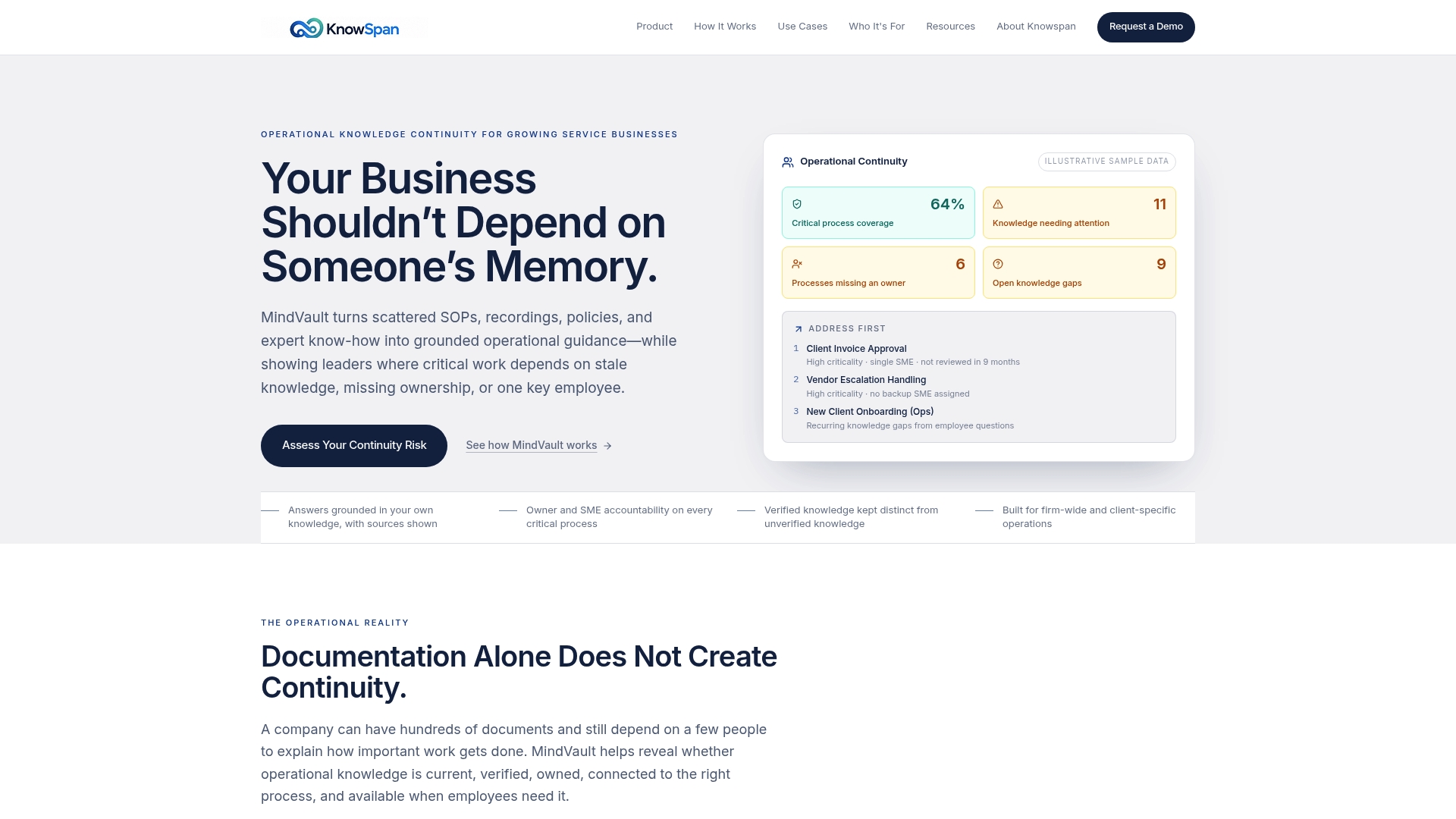
MindVault fits service businesses running on procedures scattered across people, drives, and someone's memory, especially firms with real process complexity and a handful of employees everyone quietly relies on. The Operational Continuity dashboard gives leaders that visibility directly, and unanswered employee questions get logged as a tracked backlog for subject-matter experts to resolve, instead of getting repeated every quarter.
If your last assessment turned up a "people and ownership" gap you can't confidently close, that's the signal to act. Run an Assess Continuity Risk interview with Knowspan, or request a demo of MindVault to see how the continuity dashboard maps to your own scorecard.
Sources
For readers who want to go deeper, Microsoft's operational excellence maturity model covers stage-specific strategies in more technical detail. The operations assessment framework from HowToThink.ai offers another scoring lens across reliability, effectiveness, and integration. Teams with compliance obligations should also review CISA's CMMC resources and AICPA's control-framework guidance.
- Operational excellence maturity model — Microsoft Learn
- Operations Maturity Assessment: Free Self-Scoring Tool
- IT Maturity Assessment — KPMG (PDF)
FAQ
What Are the Five Levels of a Maturity Model?
Most models use ad hoc, managed, defined, measured, and optimizing, moving from firefighting to continuous improvement backed by real metrics. Microsoft's operational excellence maturity model uses this exact structure, tying specific strategies like testing and telemetry to each stage.
What Does Operational Maturity Actually Mean?
Operational maturity means an organization runs on documented, repeatable systems rather than depending on a few people's memory and effort. It shows up in named process owners, tracked metrics, and a regular cycle of finding and fixing problems.
What Is a PMO Maturity Model?
A PMO maturity model applies the same five-stage logic specifically to project management practices, scoring things like governance, resource planning, and reporting consistency across projects. It follows the same core idea: documented and measured beats improvised and undocumented.
What Are the Four Types of Operating Models?
Operating model types generally fall into centralized, decentralized, hybrid, and shared-services structures, describing how decision rights and resources are distributed across a business. These are distinct from maturity levels. A centralized operating model can still be immature if it lacks documentation and metrics.
How Much Does an Operational Maturity Assessment Cost?
Costs vary widely by depth. A self-scoring tool can be free, while a consultant-facilitated assessment with 200-plus questions involves real advisory time, per KPMG's assessment framework. Knowspan's pricing for MindVault is available directly on its website.
Recommended
This article was researched and drafted with AI assistance and reviewed by the KnowSpan team before publishing. It's provided for general informational purposes and isn't a substitute for professional legal, compliance, or IT advisory services. For guidance specific to your organization, please consult a qualified professional or contact us directly.