
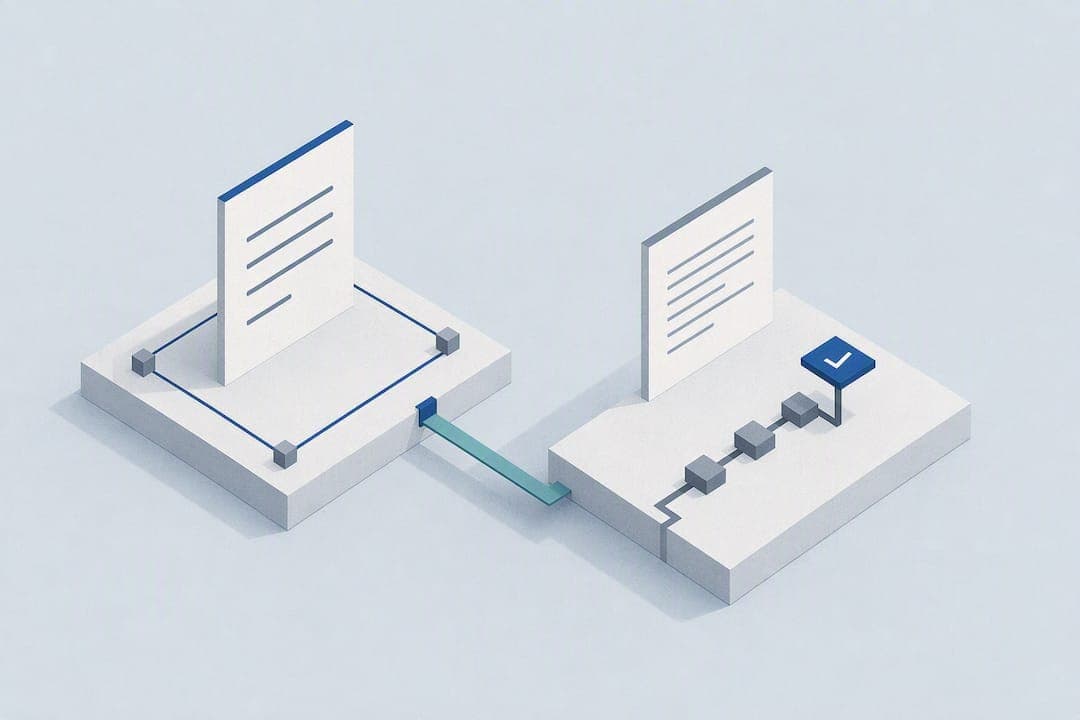
A policy states a rule and the reason behind it; a procedure spells out the exact steps to follow. Policy answers "what and why," procedure answers "how," and process is the layer connecting them by sequencing the work in between. Mixing these up is why so many compliance folders are full of documents nobody can actually use.
TL;DR:
- Most organizations mislabel or confuse policies, procedures, and processes, leading to compliance gaps and inefficiencies in document management.
- Policies state the governing rule and reason, while procedures detail specific step-by-step tasks, and processes map out stage transitions without granular instructions.
- Proper classification depends on content: policies explain rules and reasons, processes outline workflows, and procedures specify individual actions.
- Starting with the policy is essential, followed by mapping the process, then creating detailed procedures, to ensure clear ownership and audit readiness.
- Maintaining up-to-date documentation requires metadata, linked policies, owner accountability, and regular review triggers to prevent rot and ensure compliance.
Table of Contents
- Policy vs Procedure: Clear Definitions You Can Apply Today
- Policy vs Procedure vs Process: A Side-by-Side Comparison
- When Should You Write a Policy vs a Procedure?
- Best Practices for Writing and Maintaining Policies and Procedures
- Common Mistakes That Create Compliance Gaps
- How a Governed Knowledge System Applies These Rules
- Get Your Documentation Governance in Order
- My Take on Policy vs Procedure
- Sources
- FAQ
Policy vs Procedure: Clear Definitions You Can Apply Today
Getting these terms straight matters because auditors, new hires, and your own team will misclassify documents constantly if the definitions stay fuzzy. Here's how to sort them for good.
Policy is a governing statement. It names the rule, who it applies to, and why the organization cares. A policy usually includes a scope statement, an owner, an effective date, and a set of principles. It does not tell anyone how to execute a task. As the University of Texas at Austin's compliance office puts it, a policy states governing principles and rules, while a procedure records the step-by-step instructions for carrying them out.
Procedure is the instruction set. It lists steps in order, flags decision points, and names the forms or systems involved. A good procedure tells a new employee exactly what to click, sign, or check, with no guesswork.
Process sits between the two. It maps the major stages and handoffs (who does what, in what order) without listing every click. Processes are often drawn as flowcharts or swimlane diagrams, since Policycentral they document stages and decision points rather than granular steps.
Quick contrast, same topic, two departments:
- HR: Policy says "Employees are entitled to paid sick leave." Procedure says "Log into Workday, select Time Off, choose Sick Leave, attach documentation if absence exceeds three days."
- IT: Policy says "All company laptops must be encrypted." Procedure says "Open BitLocker, enable full-disk encryption, save the recovery key to the IT vault, update the asset record."
Policy vs Procedure vs Process: A Side-by-Side Comparison
Once you know the definitions, the next job is auditing what you already have. Most companies discover half their "policies" are actually procedures wearing the wrong label. Use this table to sort them.
| Dimension | Policy | Process | Procedure |
|---|---|---|---|
| Answers | Why / What | How stages connect | How, step by step |
| Audience | All employees, leadership, auditors | Cross-functional teams | Task-level staff |
| Detail level | Principle based, broad | Stage and handoff level | Granular, sequential |
| Typical owner | Executive or department head | Process owner or manager | Team lead or subject-matter expert |
| Review cadence | Annually or at policy change | When structure or handoffs change | When systems or tools change |
| Typical format | Short narrative, 1 to 2 pages | Flowchart or swimlane diagram | Numbered steps, screenshots, checklists |
A few decision rules make classification fast:
- If the document explains a rule and a reason, it's a policy.
- If it shows how work moves between people or systems, it's a process.
- If it lists exact steps someone follows at their desk, it's a procedure.
PolicyCentral.ai frames this well: policies are principle-based and owned by leadership, while procedures are detailed and owned by the operational teams closest to the work. Process documents belong to whoever manages the workflow crossing departments.
Red flags that a document is miscategorized: a "policy" with numbered steps and screenshots, or a "procedure" that never says who's responsible for the task. Both are common, and both create confusion the moment someone new tries to follow them.
When Should You Write a Policy vs a Procedure?
Most teams write procedures first because that's what people ask for. That's backwards. Start with the policy, then build down.
- Ask what rule needs to exist. If there's no governing principle yet, write the policy first.
- Map the process. Sketch the stages and handoffs before detailing any single step.
- Write the procedure last. Break the final stage into the exact actions a person takes.
- Check for orphans. A procedure with no linked policy is a compliance gap waiting to surface in an audit.
- Exception: if a policy already exists but its procedure is outdated, you can update the procedure alone. No need to touch the policy.
Worked example: Policy: "Client data must be backed up daily." Process: data flows from client systems to a nightly backup job to a verification check. Procedure: "Log into the backup console, confirm the 2 a.m. job ran, review the error log, escalate failures within one hour."
Best Practices for Writing and Maintaining Policies and Procedures
Good documentation doesn't stay good on its own. It needs metadata, a review cycle, and a communication plan, or it rots within a year.
- Record metadata on every document: owner, approver, effective date, and next review date. Diligent's governance research ties this kind of version tracking and audit trail directly to lower compliance risk.
- Split policy from procedure, then link them. Never bury steps inside a policy or principles inside a procedure.
- Train and attest. Have staff acknowledge they've read and understood a policy, not just that it exists somewhere on a shared drive.
- Use visuals for process, numbered lists for procedure. A flowchart shows handoffs; a procedure needs sequence, not diagrams.
- Set review triggers, not just calendar dates. A system change should trigger a procedure review immediately, regardless of when the last one happened.
Adoption depends on more than publishing a document. IMF research on policy communication found that explaining the "why" behind a policy, paired with consistent training and enforcement, is what actually drives compliance. Skip that step and you get inconsistent application across departments, even with a perfectly written policy.
Pro Tip: Give every policy a "linked procedures" field in your documentation system. If that field is empty, you've found a policy nobody can actually execute.
Common Mistakes That Create Compliance Gaps
Small labeling errors turn into real audit exposure. Watch for these:
- Calling a procedure a policy. This confuses staff about what's a firm rule versus what's a task guide, and it makes updates harder to track.
- Writing vague procedures. A step like "review appropriately" gives no defensible trail. The Cato Institute has argued that vague rules create a false sense of compliance, and that risk applies just as much to internal procedures reviewed during an audit.
- Mixing policy and procedure in one document. This makes the whole file need updates every time a system changes, even though the underlying rule hasn't.
- No named owner. Without one, nobody schedules the review, and the document quietly goes stale.
How a Governed Knowledge System Applies These Rules
Separating policy from procedure is easy on paper and hard at scale, once you have hundreds of documents across dozens of teams. This is the exact problem a governed knowledge platform is built to solve.
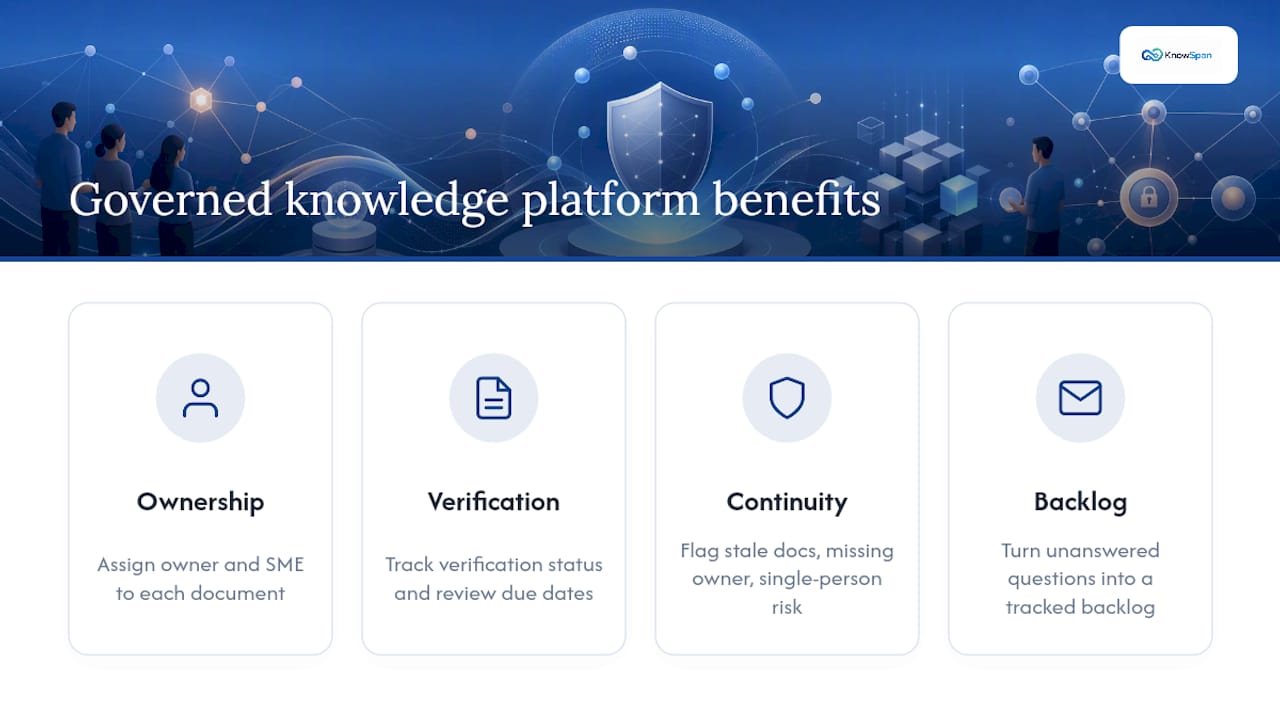
A governed knowledge platform can tie every document to an accountable owner and a subject-matter expert, and track whether that document has been verified and when it's due for review. Instead of guessing which procedures are current, an operations leader can see it directly.
An operational continuity dashboard can flag where a business depends on stale documentation, a missing owner, or a single employee who holds knowledge nowhere else. It can also turn unanswered employee questions into a tracked backlog, so subject-matter experts close real gaps instead of the same question getting asked repeatedly.
For teams supporting managed service providers, where a single missed procedure step can cause a client outage, this kind of ownership tracking isn't optional. It's the difference between catching a gap and discovering it during an incident.
Get Your Documentation Governance in Order
If your organization is still storing policies and procedures in the same document, or nobody can say who owns the review cycle, that's worth fixing before your next audit. Automating handoffs is one piece of the puzzle. Groups like Throughline Automation show how automated workflows still depend on clearly documented procedures behind them; the automation only works if the steps it follows are accurate and current.
Knowspan built MindVault specifically for service businesses juggling SOPs, recordings, and expert knowledge scattered across people and systems. You can see how the platform's product capabilities tie ownership, verification, and review cadence to every document, or request a demo to see the continuity dashboard applied to your own operation.
My Take on Policy vs Procedure
The real fix here isn't better writing. It's ownership. Pick one policy this week, find its matching procedures, and assign a named owner to each.
— Jack
Sources
- Policy vs Procedure - University Risk and Compliance Services
- Policycentral
- Communications as a policy tool — IMF blog
FAQ
What is an example of a policy and a procedure?
A policy might state "Employees may take paid sick leave." The matching procedure explains exactly how to log that leave, including which system to use and what documentation to attach.
Which comes first, policy or procedure?
Policy comes first, since it establishes the rule and reason before anyone defines the steps to follow. Procedures should always trace back to a policy, not stand alone.
What is the difference between a policy and a standard?
A policy sets the governing principle, while a standard sets a specific, measurable requirement that supports it, such as a minimum password length tied to a broader security policy. Standards are more technical and specific than the policy they support.
What is another way to say policy and procedure?
Common alternatives include "governance documents" for policy and "work instructions" or "SOPs" (standard operating procedures) for procedure. The terms overlap with process documentation, though process specifically refers to the stages linking policy to procedure.
Recommended
This article was researched and drafted with AI assistance and reviewed by the KnowSpan team before publishing. It's provided for general informational purposes and isn't a substitute for professional legal, compliance, or IT advisory services. For guidance specific to your organization, please consult a qualified professional or contact us directly.