

A process owner is the person accountable for a process's end-to-end performance, continuous improvement, and governance. Process ownership assigns that accountability to one name, not a department. Once it's assigned, handoff failures drop, incident response speeds up, and there's a clear escalation path when something breaks.
TL;DR:
- Assigning a process owner reduces handoff failures and speeds incident resolution by clearly defining accountability and escalation paths.
- Owners should establish scope boundaries, document decision limits, and maintain a process charter, matrix, and backup to ensure ongoing process stability.
- Splitting strategic ownership from operational management becomes necessary in larger organizations, with performance reviews focusing separately on process improvement and team output.
- Implementing a governed knowledge platform automates ownership tracking, alerts for stale documentation, and supports rapid response through continuous verification.
- The best process owners are domain experts with influence and data access, typically managing three to five processes for effective governance and improvement.
Table of Contents
- What Is Process Ownership, Exactly?
- What Does a Process Owner Actually Do Day to Day?
- Process Owner vs. Process Manager: What's the Real Difference?
- Why Assigning a Process Owner Actually Moves the Needle
- How to Roll Out Process Ownership This Quarter
- What Metrics Should a Process Owner Actually Track?
- Common Process Ownership Mistakes and How to Fix Them
- How a Governed Knowledge Platform Operationalizes Ownership
- Who Should Actually Hold the Process Owner Title?
- Put Process Ownership Into a System, Not a Slide Deck
- Sources
- FAQ
What Is Process Ownership, Exactly?
Process ownership means one person answers for how a process performs from start to finish, not just for the piece that runs through their department. That's the detail most org charts miss. A process owner is accountable for outcomes, not just activities, which is what separates the role from a supervisor watching a queue.
Scope matters here. An owner's authority covers the process design itself: the steps, the handoffs, the decision points. It does not automatically extend to headcount, budget, or systems outside the process. Those boundaries need to be written down, not assumed.
Three artifacts usually document that scope:
- A process charter naming the owner, the mission of the process, and the KPIs it's measured against.
- Metadata tags on the process documentation itself (owner name, backup, last review date).
- An owner contact record that's discoverable by anyone in the organization, not buried in a wiki page nobody remembers.
Decision boundaries deserve their own line item in that charter. An owner can typically approve changes to sequencing, documentation, and internal checkpoints on their own. Changes that touch compliance requirements, IT systems, or budget usually need sign off from those teams first. Skipping this distinction is how well-meaning owners end up making changes they didn't have the authority to make, and how compliance teams end up finding out about process changes after the fact instead of before.
Cambridge Dictionary's definition of process owner duties keeps it simple: define the mission, manage the documentation, set the targets, monitor performance, lead the improvement work. That's the job in five verbs. Everything past that is detail.
What Does a Process Owner Actually Do Day to Day?
The responsibilities split into two buckets: things an owner does constantly, and things they do periodically. Both matter, and skipping either one is how ownership becomes a title instead of a function.
On a rolling basis, a process owner:
- Defines the KPIs for the process and owns what those metrics actually mean, so "on time" or "resolved" isn't up for debate.
- Maintains the documentation and controls version history, so the current version is the only version anyone can find.
- Approves changes inside their authority limit and routes anything bigger to the right approval body.
- Coordinates the people who touch the process across teams, and escalates when a problem is systemic rather than a one-off.
- Sponsors automation or process redesign when it genuinely improves the outcome, not because a new tool is available.
- Names and maintains a backup owner, so the process doesn't stall if they're out sick or leave the company.
That last point gets skipped constantly. Most organizations name an owner and never ask who takes over if that person is unreachable for two weeks. Backup coverage isn't a nice-to-have. It's the difference between a process that survives a vacation and one that doesn't.
Cambridge's practitioner glossary backs this same list of duties: mission definition, documentation, target setting, performance monitoring, and improvement leadership. It's a short list. Most process owner job descriptions try to make it longer than it needs to be.
Process Owner vs. Process Manager: What's the Real Difference?
The owner sets direction. The manager runs the shop.
A process owner defines the vision for the process, sets its KPIs, and approves structural changes to how it works. A process manager handles the operational side: staffing the team, running the daily execution, watching the queue. WorkHint frames this as strategic versus operational, and that split holds up in practice.
In a 40-person company, these are often the same person, and that's fine. There isn't enough process volume to justify splitting the roles, and doing so just adds a layer of approval nobody needs. Once a company crosses roughly 100 employees, or once a single process becomes critical enough that a bad week could hurt revenue or compliance standing, splitting the roles starts to pay off. The owner protects the long view. The manager protects the next 48 hours.
This distinction should show up in performance reviews too. An owner gets measured on whether the process is improving and whether KPIs are trending the right direction. A manager gets measured on whether the team hit its numbers this month. Blending those metrics into one review is how you end up rewarding short-term firefighting over long-term process health.
Why Assigning a Process Owner Actually Moves the Needle
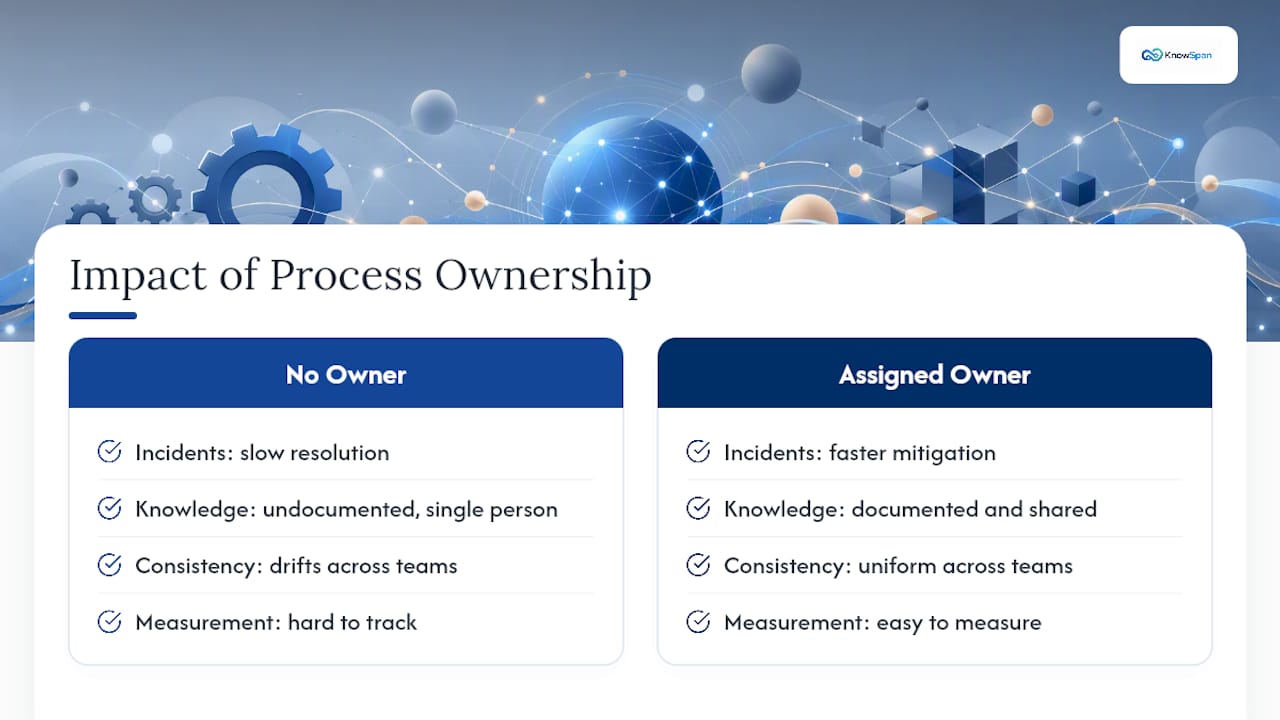
Unassigned processes fail quietly, until they fail loudly. AWS's operational excellence guidance is blunt about this: processes without an identified owner tend to fragment into scripts nobody documented and knowledge that lives only in one person's head. That's the exact setup that turns a minor outage into a multi-day scramble.
When ownership is missing, incidents take longer to resolve, not shorter. AWS notes that identified owners cut mitigation time because there's no ambiguity about who makes the call. Nobody's hunting for the right person while a customer-facing system stays down.
Consistency is the other half of the case. A process with one accountable owner runs the same way across teams and locations, instead of drifting into five slightly different versions depending on who's running it that week. Kujenga's research makes the point directly: with a single accountable person, problems have somewhere to go instead of falling into the gap between two departments that each assume the other is handling it.
Measurement gets easier too. You can't improve a process that five people half own, because nobody's tracking it consistently enough to know if it's getting better or worse. APQC's guidance on assigning process owners ties this to selecting owners with real subject-matter expertise, not just seniority. And automation only pays off when the owner shapes it toward the outcome that matters, rather than automating a broken step and making it faster to fail.
How to Roll Out Process Ownership This Quarter
Fixing missing ownership isn't a six-month project. It's a document, a matrix, and a review calendar.
1. Write the process ownership charter. Keep it to one page. It needs the process mission, the owner's name, their authority limits (what they can approve alone versus what needs sign off), the KPIs they're accountable for, and the escalation path when something breaks.
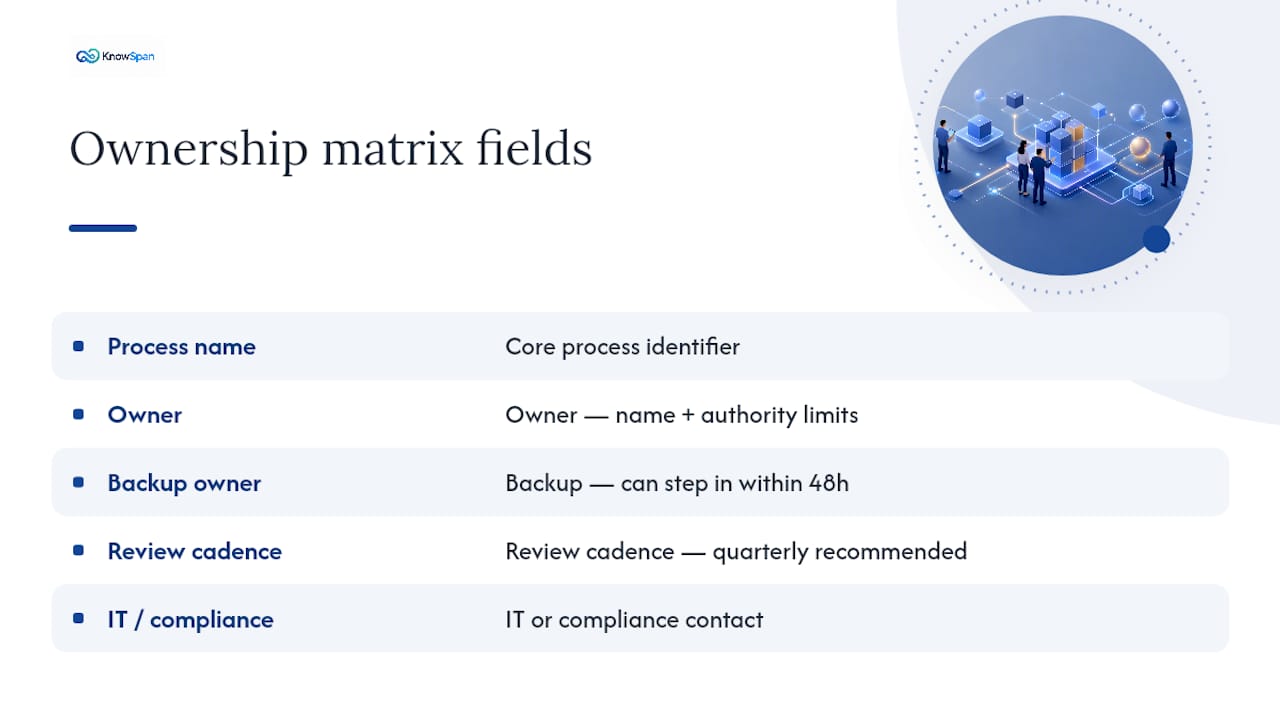
2. Build the ownership matrix. This is the single most useful artifact in the whole rollout. Every core process gets a row with five fields: process name, owner, backup owner, review cadence, and IT or compliance contact. Kissflow's guidance on BPM governance treats this matrix as the enforcement mechanism, not just documentation. Without it, ownership lives in someone's memory instead of a system.
3. Set succession rules before you need them. A backup owner should be able to step in within 48 hours of a handover request. That means the backup already knows where the documentation lives and has seen the current KPI dashboard, not just their name listed somewhere. Ownership degrades fast without an enforced backup, which is exactly why this step gets its own line instead of getting folded into "other responsibilities."
4. Set a review cadence. Quarterly reviews work for most processes. Pair that with automatic alerts when a process breaches its SLA, so problems surface between quarters instead of waiting for the next scheduled check-in.
5. Bring stakeholders in early. An owner who wasn't consulted on their own authority limits will either overreach or under-act. Ask the people who'll actually hold the role what boundaries make sense before you finalize the charter.
Pro Tip: Run a "handover drill" once a year: have the backup owner run the process solo for a week while the primary owner is unreachable. It surfaces documentation gaps faster than any audit will.
Knowspan's guidance on assessing continuity risk walks through how to spot which processes are missing this coverage before it becomes a problem.
What Metrics Should a Process Owner Actually Track?
Five KPIs cover most processes: cycle time, error or exception rate, SLA compliance, rework rate, and a measure of customer impact when the process breaks down. An owner doesn't need a dashboard with forty tiles. They need these five, tracked consistently, with alerts that fire when something crosses a threshold.
Reporting works best in three layers. Owners get a live operational view they check regularly. Executives get a rolled-up summary, not the raw detail. And exception alerts go out the moment an SLA gets breached, rather than waiting to surface in next month's report.
None of this works if the KPI definitions are shaky. Kujenga's research flags metrics governance as its own discipline: someone has to validate what "on time" means and confirm the data feeding the dashboard is actually reliable. Most owners need a data steward for this, especially when KPIs pull from multiple systems that don't always agree with each other.
Common Process Ownership Mistakes and How to Fix Them
Three patterns cause most ownership failures, and each one has a fast fix.
No owner at all. Ask: if this process broke tomorrow, who would get the call? If the honest answer is "nobody knows," that process has no owner, regardless of what the org chart says. Fix it by assigning one, with a named backup, this week.
Shared ownership. Two or three people "kind of" own a process, which functionally means nobody does. Fix it by naming a single accountable owner and turning the others into stakeholders with a defined say, not equal authority.
Stale, undocumented processes. The documentation exists but hasn't been touched in two years, and the process itself has drifted from what's written down. Fix it by adding approval gates for changes and tying documentation review to the quarterly cadence above.
For processes that fail mid-incident, a short recovery checklist helps: confirm who the named owner and backup are, pull the current documentation, check when it was last verified, and identify who has authority to approve an emergency fix. Role-based ownership, tied to a position rather than a person, holds up better than named-individual ownership when people change jobs.
How a Governed Knowledge Platform Operationalizes Ownership
Writing a charter and matrix in a spreadsheet works, until the spreadsheet goes stale and nobody notices. That's the gap a governed knowledge platform is built to close.
A governed knowledge platform ties every process directly to a named owner and subject-matter expert inside the process metadata itself, alongside its verification status and review cadence. That means the ownership matrix isn't a separate document someone has to remember to update. It's built into the record.
The platform's Operational Continuity dashboard gives leaders visibility into exactly where documentation has gone stale, where ownership is missing, and where a process depends on one person who could leave tomorrow. That's the same triage work described in the pitfalls section above, surfaced automatically instead of discovered during an incident.
Such a platform can track unanswered employee questions as a backlog for subject-matter experts to resolve, rather than letting the same gap get asked about repeatedly with no resolution. Answers are grounded in the organization's own governed knowledge, with sources shown, so employees aren't left guessing when documentation falls short.
Who Should Actually Hold the Process Owner Title?
The best process owners aren't necessarily the most senior person on the org chart. They're the person with real domain expertise, enough influence to get other teams to cooperate, and direct access to the data that shows how the process is performing. Seniority without those three things produces an owner in name only.
There's a practical cap here too. One person can realistically own three to five processes well. Past that, reviews get rubber stamped and KPIs stop getting real scrutiny. If an owner can't tell you their process's current error rate without checking, that's a sign the role has become ceremonial.
Active governance beats a title on a slide every time. A charter that nobody revisits is decoration. The organizations that get this right treat the review cadence as non negotiable, not as the first thing that gets skipped when the quarter gets busy.
— Jack
Put Process Ownership Into a System, Not a Slide Deck
A charter and an ownership matrix only work if someone keeps them current, and most teams don't have the bandwidth to chase that manually. This kind of system ties every process to an accountable owner and subject-matter expert, tracks whether documentation has been verified, and flags review cadence automatically instead of relying on someone remembering a calendar reminder.
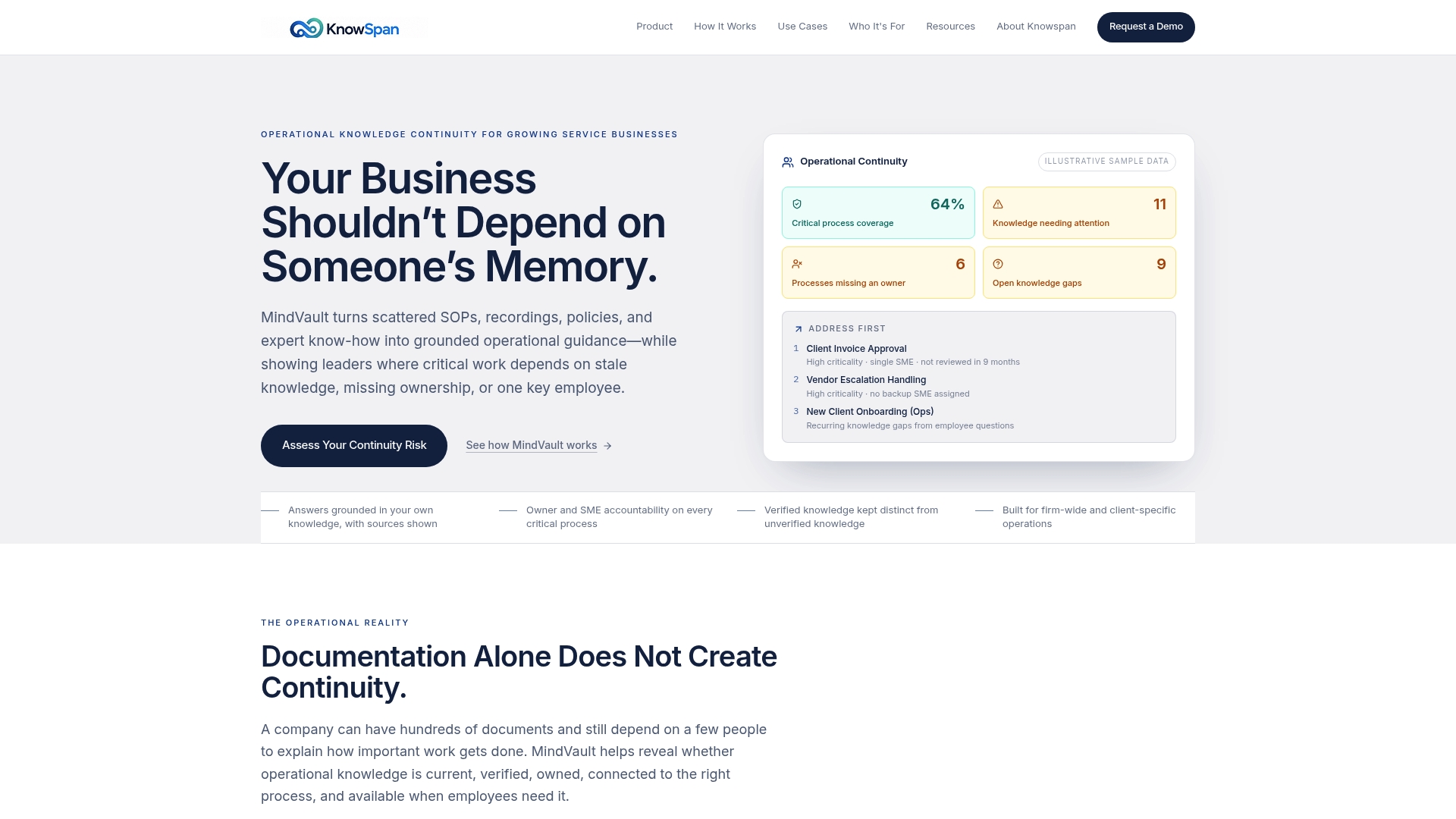
Where such platforms go further than a shared drive or a wiki is with dashboards that show exactly where a business depends on stale documentation, a missing owner, or a single employee who happens to hold the knowledge in their head, before that gap turns into an incident. Unanswered employee questions get tracked as a backlog for subject-matter experts to close, instead of getting asked again next month with no answer.
If you're not sure how exposed your organization is right now, start by assessing your continuity risk. If you want to see how the platform ties owners, verification, and dashboards together, check out MindVault directly.
Sources
For readers who want the primary guidance behind the recommendations above:
- 6sigma
- AWS Well-Architected — Operational Excellence pillar (Processes and procedures have identified owners)
- Business process owners — APQC
- The Role of Process Ownership in Business Performance — Kujenga
FAQ
What Does Process Ownership Mean?
Process ownership means one accountable person is responsible for a process's end-to-end performance, documentation, and continuous improvement. It's different from managing a team, since a process owner focuses on outcomes across the entire process, not just their department's piece of it.
What Is Another Term for "Process Owner"?
Some organizations use "process sponsor" or "process champion," though these terms don't always carry the same formal authority. The clearest version of the role still ties directly to defined KPIs and documented decision authority, as outlined in a process ownership charter.
What Are Examples of Business Process Management?
Business process management, or BPM, covers work like onboarding a new client, processing an insurance claim, or handling an IT service request from ticket to resolution. Each of these benefits from a named owner who tracks the KPIs, since consistent accountability is what keeps a process from drifting into five different versions across teams.
What Do Business Process Owners Do?
A business process owner defines KPIs, maintains documentation, approves changes within their authority limits, and leads improvement work on their process. They also coordinate the stakeholders who touch that process and name a backup owner so the work doesn't stall if they're unavailable.
How Does MindVault Help With Process Ownership?
MindVault ties each process to a named owner and subject-matter expert, tracks verification status and review cadence, and flags where documentation or ownership has gone stale through its Operational Continuity dashboard. Pricing details are available directly on the MindVault site.
Recommended
This article was researched and drafted with AI assistance and reviewed by the KnowSpan team before publishing. It's provided for general informational purposes and isn't a substitute for professional legal, compliance, or IT advisory services. For guidance specific to your organization, please consult a qualified professional or contact us directly.