

A playbook governs the response; a runbook executes the steps. During a major incident, the playbook decides who acts, when they escalate, and which procedure to run, while the runbook supplies the exact commands and verification steps that fix the problem. Neither replaces the other. Effective incident response depends on both working together.
TL;DR:
- Runbooks must be tested, version-controlled, and maintained to ensure accuracy, especially since outdated instructions can worsen incident response.
- Playbooks coordinate teams and escalate incidents but should not contain technical commands, which are the domain of runbooks.
- During major incidents, playbooks define roles and escalation paths, while runbooks execute specific remediation steps either manually or automatically.
- Automating runbook execution through decision gates and logging enhances operational reliability and post-incident analysis.
- Ownership and regular verification are critical to prevent staleness and dependency risks, ideally managed with dedicated platforms like MindVault.
Table of Contents
- Runbook vs Playbook: What Is a Runbook?
- Runbook vs Playbook: What Is a Playbook?
- Key Differences Between Runbook and Playbook
- When to Use a Runbook vs a Playbook
- How Runbooks and Playbooks Integrate
- How to Create and Maintain Runbooks and Playbooks
- Runbook and Playbook Examples You Can Adapt
- The Governance Gap Nobody Plans For
- Govern Your Runbooks and Playbooks With MindVault
- Sources
Runbook vs Playbook: What Is a Runbook?
A runbook is a tactical, step-by-step procedure for one specific technical task, such as restarting a database cluster or failing over a load balancer. It exists to remove ambiguity: the engineer running it should not have to make judgment calls, only follow the sequence.
Runbooks come in a few forms. Some are manual documents an on-call engineer reads line by line. Others are automated or "executable," triggered through a script or a runbook automation (RBA) platform that carries out the steps without human input. Runbook automation is tied to measurable operational goals, including lower mean time to repair and higher mean time between failures, but only when the underlying steps are tested and reversible.
A solid runbook includes:
- Preconditions that confirm the system is in the expected state before you start
- The exact commands or API calls, not paraphrased descriptions
- Expected output at each step, so deviations are caught immediately
- A verification step confirming the fix worked
- A rollback path if it did not
Runbooks need version control, a named owner, and periodic testing, because a runbook that has not run since last year is a liability disguised as documentation.
Runbook vs Playbook: What Is a Playbook?
A playbook governs coordination, not commands. It defines how a team responds to a category of event, covering who does what, when to escalate, and which runbooks to invoke along the way.
The audience for a playbook is broader than for a runbook. An incident commander uses it to run the event. A communications lead uses it for status update templates. Legal or compliance stakeholders may have defined inputs during specific event types, like a data breach.
Typical playbook contents include:
- Declaration criteria: what conditions turn an alert into a formal incident
- Escalation rules and role assignments, including who has authority to call the incident
- Communication templates for internal updates and external customer or regulator notices
- Pointers to the specific runbooks relevant to that incident type
AWS Well-Architected guidance frames playbooks as a way to preserve institutional knowledge and standardize investigation steps, which matters more as teams grow and staff turnover accelerates. Playbooks typically get reviewed on a slower cadence than runbooks, often tied to post-incident retrospectives rather than routine maintenance.
Key Differences Between Runbook and Playbook
The two documents differ in scope, granularity, audience, and update triggers. A runbook is narrow and mechanical; a playbook is broad and situational.
- Scope: Runbooks address one technical task. Playbooks address a category of incident or business scenario.
- Granularity: Runbooks specify exact commands and expected outputs. Playbooks use decision logic and branching, not fixed steps.
- Audience: Runbooks are written for the engineer executing the fix. Playbooks serve incident commanders, communications leads, and sometimes legal or executive stakeholders.
- Where they live: Runbooks tend to sit in engineering wikis or automation tools. Playbooks often live in incident management platforms alongside escalation policies.
- Update triggers: Runbooks change when the underlying system or command set changes. Playbooks change after retrospectives, policy shifts, or org restructuring.
TechTarget's comparison of the two document types notes that playbooks coordinate people while runbooks fix the technology, and confusing the two is a common source of delay. An engineer handed a playbook when they need exact commands wastes minutes hunting for detail that was never meant to be there. A coordinator flipping through a runbook looking for escalation paths faces the same problem in reverse. Both mistakes extend mean time to resolution, and both are entirely avoidable with clear document boundaries.
When to Use a Runbook vs a Playbook
Matching the right document to the right moment keeps a P1 incident from turning into a scramble.
- Major incident management (P1): The playbook governs the overall response, deciding who leads, who communicates, and when to escalate. Runbooks execute the specific remediation steps the playbook points to.
- Disaster recovery and cloud failover: A DR playbook sequences the overall recovery order across systems, while individual runbooks handle each system's failover commands and verification.
- Cyber incident containment: A cyber response playbook coordinates containment decisions, legal notification thresholds, and forensic handoffs, while runbooks isolate compromised hosts or rotate credentials.
- Routine operations and onboarding: Runbooks document repeatable maintenance tasks new engineers can follow unsupervised. Playbooks explain broader operational policy, useful for onboarding into a team's culture and escalation norms.
Practitioner accounts of incident response consistently show that runbook-led execution paired with structured playbook coordination cuts resolution time compared to ad hoc, chat-driven troubleshooting.
How Runbooks and Playbooks Integrate
The connection between the two documents is where most of the operational value sits. A playbook reaches a decision point and either instructs a human to run a specific runbook or, in more mature setups, triggers it automatically through an orchestration tool.
- Manual triggers: The playbook tells the incident commander which runbook applies; a human decides to execute it.
- Automated triggers: Monitoring detects a condition, the playbook's logic evaluates it, and a runbook fires without waiting for approval, provided a decision gate confirms it is safe to proceed.
- Decision gates: Automation should pause for confirmation before irreversible actions, like deleting data or shifting production traffic.
- Audit trails: Every runbook execution should log what ran, when, by whom, and what the output was, creating an immutable record for post-incident review.
Runbook automation platforms are built around this discipline, pairing automated execution with verification and rollback so a triggered runbook doesn't quietly make things worse.
Pro Tip: Log runbook invocations with a timestamp and trigger source, even for manual runs. Without that record, your post-incident review becomes guesswork about what actually happened and when.
How to Create and Maintain Runbooks and Playbooks
Documentation that nobody owns decays fast. Building both document types with ownership baked in from day one avoids the slow drift into unreliable, unverified instructions.
- Name an accountable owner before writing anything. Every runbook and playbook needs one person responsible for accuracy, not a team.
- Keep runbooks minimal and testable. Strip anything that isn't a command, expected output, or verification step.
- Keep playbooks decision-focused. Resist the urge to embed technical detail that belongs in a linked runbook instead.
- Version control both document types, and run scheduled reviews rather than waiting for an incident to expose staleness.
- Automate testing where you can. AWS Well-Architected guidance recommends verifying runbooks are reversible and instrumented, not just written.
- Track freshness and verification status as a metric, not a hope. A dashboard that flags stale documentation or single-owner dependencies turns maintenance into a prioritized task list instead of a vague obligation.
A continuity scorecard approach works well here: rank documents by how recently they were verified and how exposed the business is if the one person who understands them leaves.
Runbook and Playbook Examples You Can Adapt
A short incident playbook fragment might read: "Declare a P1 when customer-facing latency exceeds 2 seconds for 5 minutes. Incident commander assigned from on-call rotation. Communications lead posts status updates every 15 minutes to the status page. Reference: Database Failover Runbook, API Gateway Restart Runbook."
A runbook snippet for that database failover might look like: "Precondition: replica lag under 5 seconds. Command: failover promote replica-02. Expected output: replica-02 status: primary. Verification: run health check endpoint, confirm 200 response. Rollback: failover promote replica-01 if health check fails."
- Store playbooks in your incident management platform, alongside escalation policies and contact rosters.
- Store runbooks in a version-controlled docs repository or automation tool where engineers actually work.
The Governance Gap Nobody Plans For
Most teams get the definitions right and still fail at governance. A playbook-first approach works well at small scale: define your incident categories and escalation logic first, then add runbooks only for the failure modes that actually recur. Writing exhaustive runbooks before you understand your real failure patterns wastes engineering time on documentation nobody will ever run.
The bigger risk is staleness with no owner attached. A runbook that references a decommissioned server, or a playbook naming an escalation contact who left the company eighteen months ago, is worse than no document at all, because it creates false confidence during exactly the moment confidence matters most. Governance that tracks ownership and verification status directly addresses key-person dependency, turning "only Dave knows how this works" from a standing risk into a flagged gap someone is assigned to close.
— Jack
Govern Your Runbooks and Playbooks With MindVault
A platform exists for service businesses that have outgrown scattered docs, tribal knowledge, and a wiki nobody trusts. Instead of hoping your runbooks and playbooks stay current, The platform ties every document to an accountable owner and subject-matter expert, tracks whether it has been verified, and shows sources when an employee asks a question grounded in that documentation.
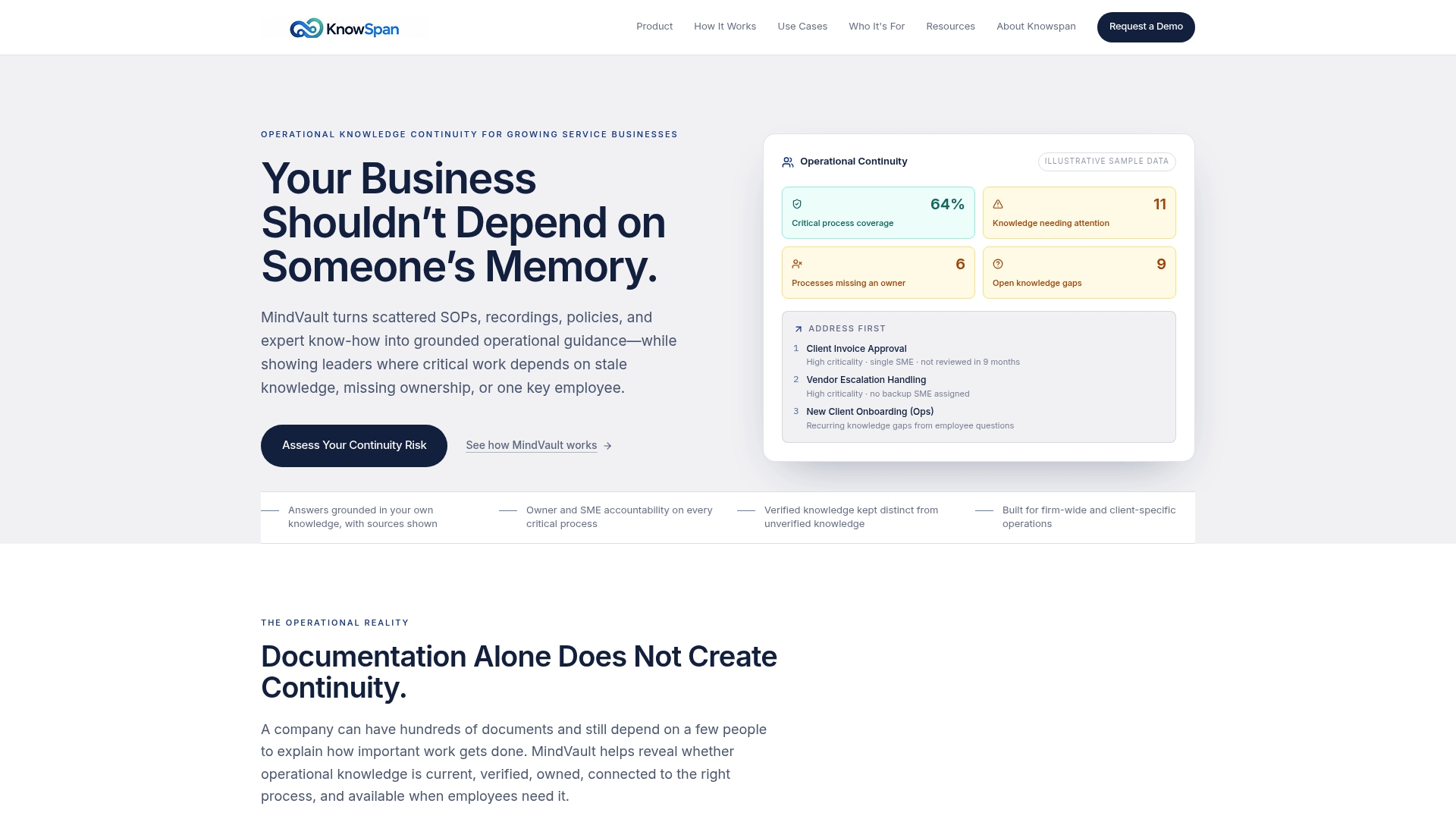
An Operational Continuity dashboard can surface exactly where the business depends on stale documentation, a missing owner, or a single person who holds knowledge nowhere else. Unanswered employee questions can become a tracked backlog instead of repeated interruptions for subject-matter experts. If you want to see where your own documentation is exposed, you can assess your continuity risk or learn more about this type of platform here.
Sources
- Playbook — AWS Well‑Architected
- Compare runbooks vs. playbooks for IT process documentation — TechTarget
- Runbooks vs playbooks: Key Differences and When to Use Each — Cutover