

Vendor compliance tracking, in the context that matters for operations leaders, means tracking whether your own internal processes are documented, owned, verified, and followed. The fix starts with a bottleneck audit: identify which processes have only one person who knows how to run them. Then assign a documented backup for each one. The rest of this guide walks through a rollout you can start this week.
TL;DR:
- Regularly conducting a bottleneck audit helps identify single points of failure that could threaten business continuity if key employees become unavailable.
- Tracking detailed process attributes like ownership, backup, verification status, and evidence artifacts ensures operational procedures remain current and effective.
- Running short-term unavailability tests for high-risk processes, twice a year, provides realistic validation of a firm’s ability to maintain continuity during staff absences.
- Employee involvement in process documentation significantly increases SOP adoption, making procedures more accurate and less likely to go stale.
- MindVault facilitates ongoing vendor compliance by centralizing process data, tracking risk indicators, and enabling real-time visibility into operational health.
Table of Contents
- What Does Vendor Compliance Tracking Actually Mean for Operations Teams?
- What Should You Track for Every Process?
- How Do You Roll Out Vendor Compliance Tracking in 90 Days?
- How Do You Measure Whether Your Continuity Program Is Working?
- Why Do Documentation Efforts Fail, and What Fixes Them?
- How Does MindVault Support Vendor Compliance Tracking?
- Why Documentation Is a Growth Lever, Not Just a Risk Control
- How Knowspan Helps You Put This Into Practice
- Sources
What Does Vendor Compliance Tracking Actually Mean for Operations Teams?
For an operations leader running an accounting firm, a property management company, or a managed service provider, this discipline is about internal process compliance, not chasing supplier paperwork. It tracks whether the procedures your own team relies on are documented, assigned to an accountable owner, verified as current, and actually followed day to day. This is often called operational continuity or vendor compliance management when applied internally, and it covers a different problem than tracking a supplier's insurance certificates or W-9 forms.
That distinction matters because the risks are different too. A firm with strong internal process compliance can survive a key employee quitting, a manager going on leave, or a client audit request without scrambling. A firm without it discovers, usually at the worst possible moment, that only one person knew how to close the books, run payroll, or handle a tenant emergency.
The stakes show up in three places:
- Client retention: service consistency breaks down when the person who "just knows how to do it" is unavailable.
- Investor and acquirer signals: buyers evaluate firms on whether service quality depends on specific individuals or on the business itself.
- Regulatory and audit exposure: undocumented processes are hard to defend when a client or examiner asks how a task is actually performed.
What Should You Track for Every Process?
Effective vendor compliance tracking runs on a defined set of fields for every documented process, not a loose folder of files. Treat each process like a record with required attributes, the same way you would treat a client engagement or a project file.
- Owner and backup. Every process needs a named accountable owner and at least one documented backup who could execute it without help.
- Evidence artifacts. Attach the actual proof: screen recordings, screenshots, checklists, or sample outputs, not just a written narrative.
- Verification status and reviewer. Mark whether a process has been checked against reality recently, who checked it, and when.
- Review cadence. Set a re-verification schedule (monthly for high-risk workflows, quarterly for stable ones) so documentation doesn't quietly go stale.
- Audit trail and version history. Keep a record of what changed, when, and why, so you can trace a process back through its revisions.
- SME notes and exceptions. Capture the judgment calls and edge cases the subject-matter expert handles that a generic SOP would miss.
- A feedback loop. When an employee asks a question the documentation doesn't answer, that question becomes a tracked backlog item for the SME to resolve, rather than a gap that repeats indefinitely.
Skip any one of these fields and the tracking system degrades into a document library. It tells you what exists, not whether it works.
How Do You Roll Out Vendor Compliance Tracking in 90 Days?
Start with an audit, not a documentation sprint. Practitioners who study firm continuity consistently point to deliberately stepping away as the fastest way to find real dependencies, because it reveals what actually breaks instead of what people assume matters.
- Phase 0 (before week 1): run a bottleneck audit. Identify every process with a single point of failure by asking who could not take a week off without the business feeling it. This is the same logic behind a planned absence exercise: you learn more from someone actually being unreachable than from a self-reported risk survey.
- Weeks 1 to 4: map and assign. Inventory critical processes, assign a named owner and backup to each, and record SME walkthroughs on video while the expert performs the actual work, not a retrospective summary.
- Weeks 5 to 8: convert and schedule. Turn the recorded walkthroughs into verified SOPs, assign a review cadence to each, and have a second qualified person confirm the documentation matches reality.
- Weeks 9 to 12: activate tracking and test. Turn on ownership, verification, and review-cadence fields inside your tracking system, then run a validation test (more on this in the next section) and iterate on whatever fails.
| Phase | Primary owner | Governance cadence |
|---|---|---|
| Bottleneck audit | Operations leader | One-time, revisit annually |
| Mapping and capture | Process owners + SMEs | Weekly check-ins |
| SOP conversion | SMEs with operations review | Bi-weekly sign-off |
| Tracking and validation | Operations leader | Monthly dashboard review |
Pro Tip: Don't wait until week 9 to test anything. Run a small, low-stakes absence spot check in week 3, on a noncritical role, so you catch process gaps in your documentation approach before they compound across dozens of workflows.
How Do You Measure Whether Your Continuity Program Is Working?
A continuity score gives you one number that reflects three inputs: documentation completeness, verification status, and backup coverage. When any of the three lags, the score drops, and you know exactly where to focus remediation instead of guessing.
The most direct validation test borrows from how operational resilience is assessed more broadly: resilience is a property of the system, not of any one reliable employee. A common benchmark used in continuity assessments is a short-term unavailability test of about two weeks. If a critical process owner is unreachable for two weeks and the work cannot get done safely and on time, that process fails the test regardless of how well-liked or competent the owner is.
Run validation at two scales:
- Full 14-day tests for your top three to five highest-risk process owners, once or twice a year.
- Smaller spot checks, a day or two at a time, for lower-risk roles, run more frequently to catch drift early.
Continuity metrics worth putting on a dashboard: continuity score by department, percentage of processes with a verified backup, average days since last review, and count of unresolved employee questions logged against a process. Share the dashboard monthly with operations leadership and a rolled-up scorecard quarterly with executive leadership, so trend lines, not just snapshots, drive prioritization.
Why Do Documentation Efforts Fail, and What Fixes Them?
Most compliance tracking programs fail for a predictable reason: documentation gets written by someone other than the person doing the work, then imposed from the top down. Employees treat it as paperwork instead of their own process, and it goes stale within months.
The research on SOP adoption is consistent: involving subject-matter experts directly in capture is the single most effective way to drive adoption, because people follow documentation that reflects how they actually work.
- Make documentation searchable and mobile-accessible, not buried in a shared drive nobody opens.
- Have managers visibly follow the same documented processes they expect their teams to use.
- Train on the documentation before enforcing it, rather than announcing a policy and hoping compliance follows.
- Recognize teams that keep documentation current, since recognition sustains behavior that mandates alone rarely do.
Pro Tip: When an employee asks a question your SOP doesn't answer, don't just answer it and move on. Log it as a documentation gap and route it to the SME. Otherwise five other people will ask the same question next quarter.
How Does MindVault Support Vendor Compliance Tracking?
MindVault is an operational knowledge and continuity platform built around the fields this article recommends tracking. Every process lives in one governed system, tied to a named owner and SME, with verification status visible at a glance instead of buried in someone's inbox.
- An operational continuity dashboard can flag stale documentation, missing ownership, and single-person dependencies before they become emergencies, not after.
- Continuity scorecards and operations interview frameworks provide ways to assess where risk concentrates and to run SME walkthroughs that surface tacit knowledge.
- Unresolved employee questions can be logged automatically as a backlog for SMEs to address gaps rather than letting them repeat.
- Employees may be able to ask operational questions in plain language and receive answers grounded in organizational knowledge with sources cited.
For a firm running dozens of interlocking processes across accounting, property management, or managed IT services, this turns continuity from a spreadsheet nobody updates into a live operating picture.
Why Documentation Is a Growth Lever, Not Just a Risk Control
Treating this as compliance paperwork misses the point. Every process you document properly frees your subject-matter experts from being interrupted constantly, and every dependency you remove is a risk your firm no longer carries. Clients feel the difference too: service consistency doesn't depend on which employee happens to answer the phone. Run the bottleneck audit this month. It's the cheapest diagnostic you'll ever run, and it tells you exactly where your firm is exposed.
— Jack
How Knowspan Helps You Put This Into Practice
MindVault is designed for service businesses to centralize documentation, assign owners, and surface risk through dashboards and scorecards rather than static files.
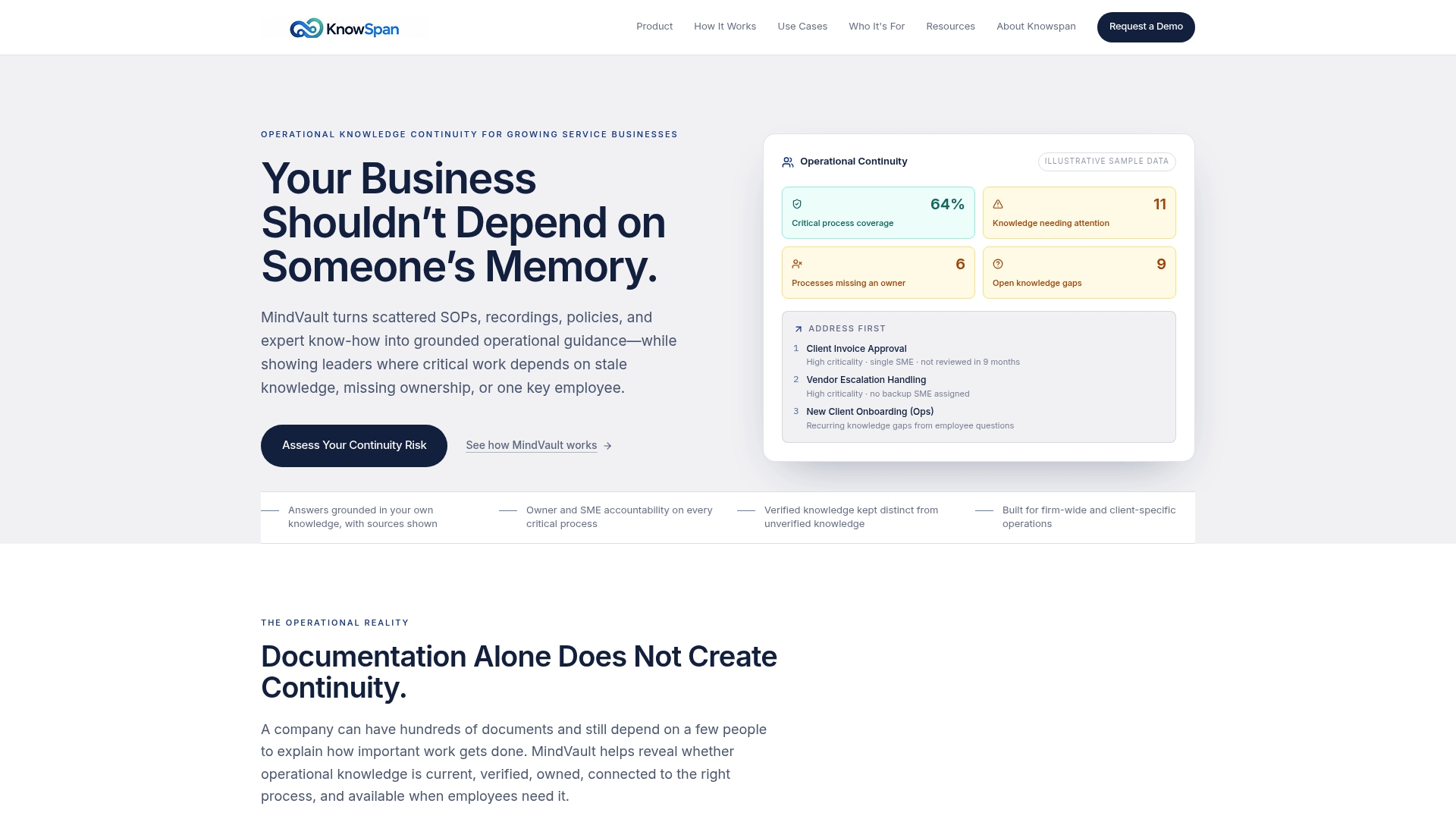
If you want to see where your own firm stands before committing to a full rollout, start with Assess Continuity Risk to get a scorecard baseline, or explore the MindVault product directly to see how ownership, verification, and dashboards work together. Firms managing distributed teams, such as property management companies and managed service providers, tend to feel the single-point-of-failure problem earliest. Consider booking a walkthrough with a vendor to identify continuity gaps before they lead to operational disruptions.
Sources
- What is operational resilience? | Elastic
- Building SOP culture & employee adoption | WorkProcedures
- Operations that survive the founder leaving | Ivan Boban